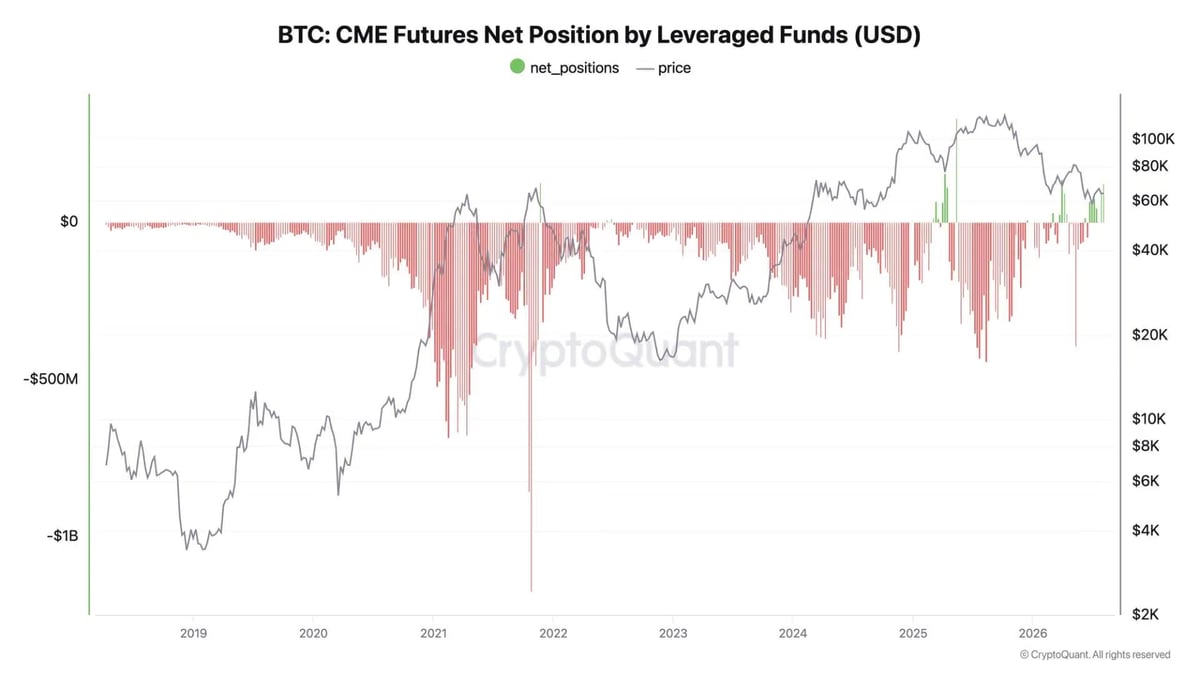
Hedge funds trading Bitcoin futures on the Chicago Mercantile Exchange (CME) have moved into net-long territory, marking a notable change from years of structural short positioning.
The shift, highlighted by CryptoQuant CEO Ki Young Ju, suggests that professional investors may be becoming more optimistic about Bitcoin’s near-term price outlook.
The change also comes as declining futures premiums make the traditional Bitcoin basis trade less attractive, potentially pushing institutional traders toward outright bullish exposure.
CME Hedge Funds Flip Bullish on Bitcoin
Leveraged funds on the CME have historically maintained significant short exposure to Bitcoin futures.
That positioning has largely been associated with the basis trade, a market-neutral strategy in which traders purchase Bitcoin or spot Bitcoin ETFs while simultaneously shorting futures contracts.
The strategy attempts to capture the difference between Bitcoin's spot price and its futures price rather than directly betting on BTC's direction.
CryptoQuant CEO Ki Young Ju said the latest positioning represents a rare departure from that pattern.
“Hedge funds on CME have flipped net long on bitcoin futures.”
A sustained net-long position would mean leveraged funds now hold more long futures contracts than shorts, indicating that at least part of the institutional market is positioning for Bitcoin to rise.
Bitcoin Basis Trade Loses Its Appeal
One of the biggest factors behind the positioning change is the declining return available from Bitcoin futures.
The annualized three-month Bitcoin futures basis has fallen to around 3%, according to market data cited in the original report.
That compares with approximately 3.8% on two-year U.S. Treasury notes, making the traditional crypto basis trade considerably less attractive on a risk-adjusted basis.
When futures premiums are high, hedge funds can potentially earn attractive returns by buying spot Bitcoin and selling futures.
But when the premium falls, the strategy becomes less compelling after accounting for:
Financing costs
Margin requirements
Trading fees
Execution risks
Custody expenses
Capital requirements
As a result, some traders may choose to close their futures shorts rather than continue running a low-yield market-neutral position.
Why the Shift Matters for Bitcoin
The move from structural shorts toward net-long exposure is significant because CME futures are widely used by institutional investors.
A change in positioning does not guarantee that Bitcoin will continue rising, but it can provide insight into how sophisticated market participants are positioning themselves.
The distinction is particularly important because simply reducing futures shorts would not necessarily mean traders are bullish.
However, moving all the way into net-long territory indicates that aggregate long exposure has overtaken short exposure.
That makes the latest CME data potentially more meaningful than a simple decline in short interest.
Bitcoin Recovery Strengthens the Bullish Case
Bitcoin has also recovered significantly from its recent low.
BTC fell toward approximately $58,000 on July 1 before recovering above the $65,000 level.
The combination of price recovery and changing institutional futures positioning could indicate that some professional traders are becoming more comfortable taking directional exposure to Bitcoin.
The development also comes after a period of strong institutional interest in spot Bitcoin ETFs.
Bitcoin ETF inflow data has become an important indicator for tracking institutional demand, with ETF flows often influencing market sentiment and liquidity.
CME Futures and Spot Bitcoin ETFs Tell Different Stories
Bitcoin futures positioning should not be viewed in isolation.
Spot Bitcoin ETFs provide another way for institutions to gain exposure to BTC, while CME futures allow traders to use leverage, hedge positions or express directional views.
When futures traders maintain large structural shorts while ETF demand remains strong, the two markets can tell different stories.
The latest CME shift could reduce that divergence if leveraged funds increasingly use futures to establish outright long exposure instead of simply hedging spot positions.
That could potentially increase the sensitivity of Bitcoin futures markets to bullish price movements.
The Basis Trade Was a Major Source of Institutional Shorting
For years, the Bitcoin basis trade helped explain why hedge funds appeared consistently bearish in futures positioning despite Bitcoin's long-term appreciation.
The strategy does not require traders to believe Bitcoin will fall.
Instead, a fund could purchase BTC in the spot market while selling a futures contract at a premium. If the futures premium eventually converges toward the spot price, the fund captures the spread.
This means large futures short positions can sometimes represent market-neutral institutional strategies rather than bearish convictions.
The current shift is therefore notable because falling basis yields may be forcing traders to reconsider whether that strategy still offers enough return.
Lower Futures Yields Could Change Institutional Positioning
If the Bitcoin futures basis remains near current levels, institutional investors may have less incentive to allocate capital toward basis strategies.
That could have several consequences for the market.
First, some existing futures shorts could continue to be closed.
Second, capital previously dedicated to market-neutral strategies could move toward other opportunities.
Third, hedge funds that maintain Bitcoin exposure may become more willing to hold directional futures positions.
None of these outcomes is guaranteed, but they could contribute to a changing structure in the Bitcoin derivatives market.
What the CME Shift Means for BTC
The move by CME leveraged funds into net-long territory is an important signal, but it should not be interpreted as proof that Bitcoin is entering a new rally.
Institutional positioning can change rapidly, particularly when futures premiums, interest rates and volatility shift.
Still, the combination of lower basis yields, reduced incentive for structural shorts and rising Bitcoin prices creates a notable backdrop for BTC.
If hedge funds continue increasing their net-long exposure while spot Bitcoin demand remains strong, the shift could become a more meaningful confirmation of institutional bullish sentiment.
Final Thoughts
Hedge funds turning net long on CME Bitcoin futures represents a significant change from the structural short positioning that has dominated the market for years.
The decline in Bitcoin futures yields appears to be weakening the economics of the traditional basis trade, giving professional investors less reason to maintain large market-neutral futures shorts.
At the same time, Bitcoin's recovery above $65,000 provides a stronger backdrop for directional positioning.
For the Bitcoin market, the key question now is whether the CME shift is temporary or the beginning of a broader institutional repositioning.
If futures traders continue moving long while spot demand remains resilient, institutional positioning could become an additional tailwind for Bitcoin's next major move.