Hyperliquid open interest reaches record levels
Hyperliquid’s total perpetual futures open interest climbed above $11 billion on July 13, marking its highest level of 2026.
Trading activity has also expanded significantly. Perpetual futures volume reached nearly $178 billion over the previous 30 days, giving Hyperliquid a growing share of the global perpetual futures market.
The growth has been particularly strong in markets outside traditional crypto assets.
However, protocol revenue has moved in the opposite direction.
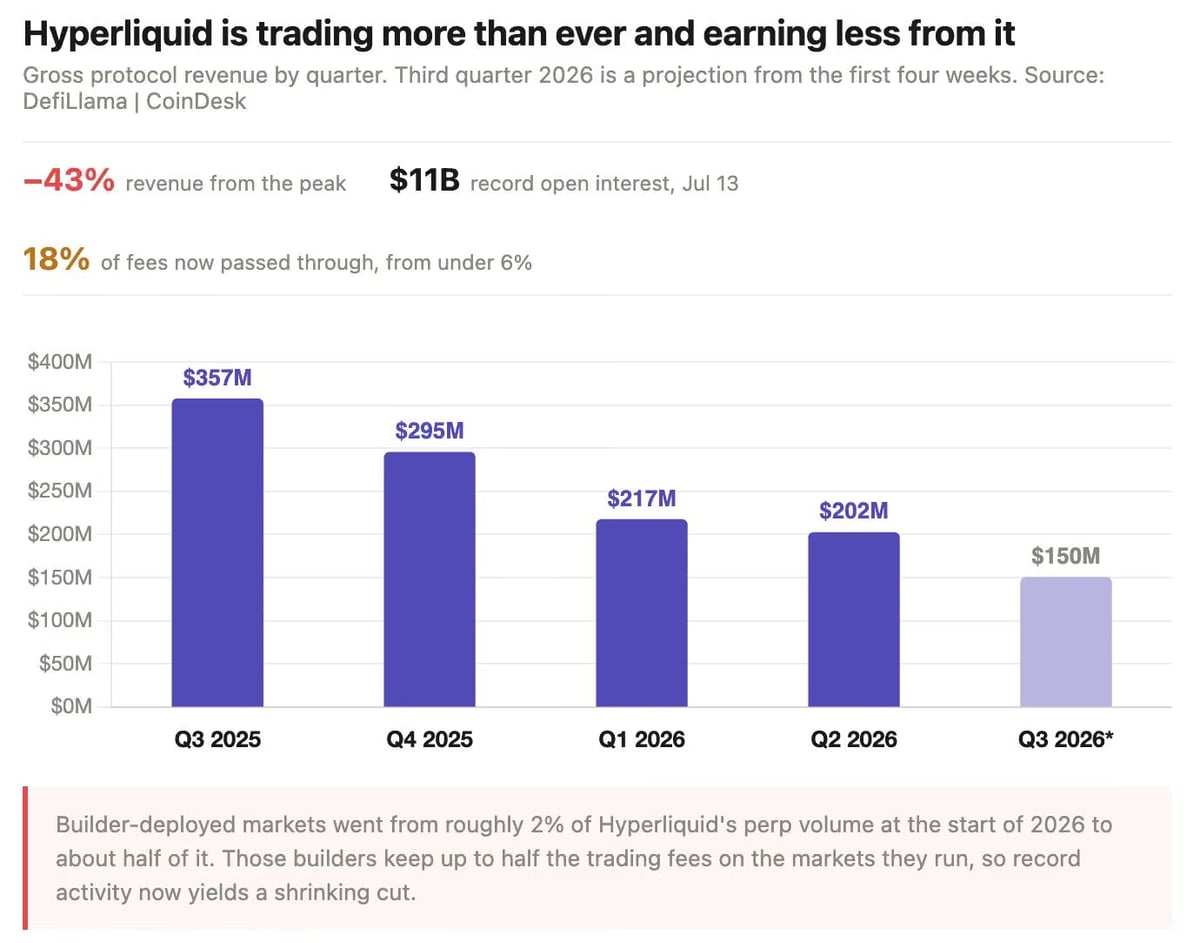
According to DefiLlama’s Hyperliquid data, gross protocol revenue peaked at approximately $357 million in Q3 2025 before declining to around $295 million, $217 million and roughly $202 million in Q2 2026.
That represents a decline of about 43% from the peak, despite continued growth in trading activity.
HIP-3 changes how Hyperliquid captures fees
One of the main factors behind the divergence is Hyperliquid’s HIP-3 framework.
Introduced in October 2025, HIP-3 allows eligible builders to deploy their own perpetual futures markets using Hyperliquid’s infrastructure.
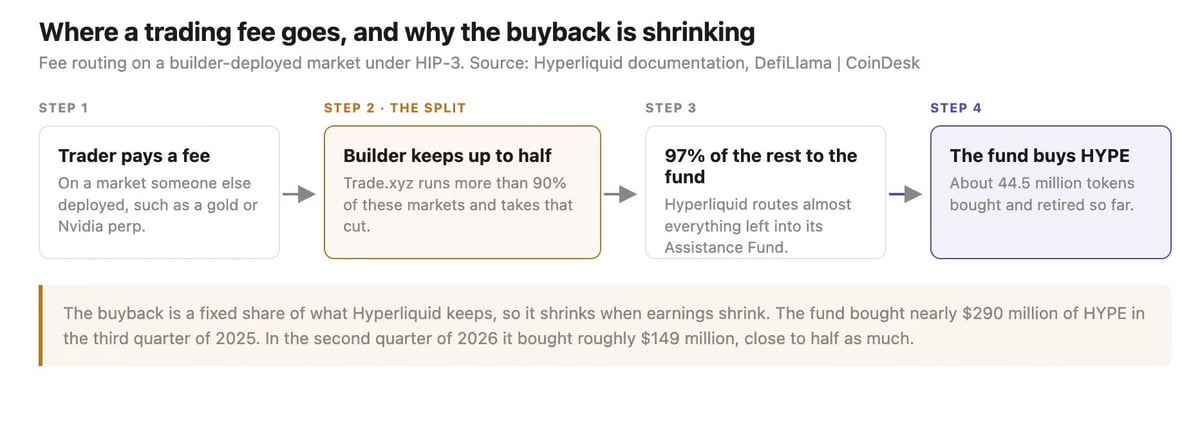
Builders must stake 500,000 HYPE to launch a market and can retain as much as half of the trading fees generated by their markets.
Hyperliquid HIP-3 documentation
The model has helped expand the range of assets available to traders, but it also means Hyperliquid does not retain the entire economic value generated by the additional trading activity.
Builder-deployed markets represented only around 2% of perpetual futures volume at the beginning of 2026.
They now account for roughly half of the platform’s activity.
RWA perpetuals become a major growth engine
Much of that growth is coming from perpetual contracts linked to real-world assets.
These markets allow traders to gain leveraged exposure to assets such as:
Gold
Crude oil
Nvidia
Tesla
Nasdaq-100
Pre-IPO companies
RWA perpetual futures reached approximately $3.6 billion in open interest, making the category larger than Bitcoin on Hyperliquid by that measure.
During the week of July 13–19, tokenized stocks and commodities generated approximately $25 billion in trading volume, representing around 52% of Hyperliquid’s weekly total.
The appeal is partly structural.
These perpetual contracts can trade around the clock, settle in stablecoins and remain available during weekends when traditional U.S. equity markets are closed.
That creates a product for traders looking for leveraged exposure to traditional assets outside conventional market hours.
Trade.xyz dominates RWA activity
The rapid expansion of RWA markets also creates concentration risks.
Trade.xyz reportedly accounts for more than 90% of HIP-3 open interest, making it the dominant builder behind Hyperliquid’s RWA perpetual market.
That concentration means a large portion of activity depends on one operator's decisions around pricing oracles, margin requirements and risk controls.
Those risks became visible when a trade on a thin Korean pre-market venue caused Trade.xyz's SK Hynix perpetual contract to fall sharply.
The move triggered liquidations, prompting Trade.xyz to agree to reimburse affected traders.
The incident illustrates one of the challenges of bringing real-world assets into decentralized perpetual markets: the quality of external price feeds and market infrastructure can directly affect leveraged positions.
Rising payouts reduce the revenue retained by Hyperliquid
Hyperliquid's growing builder ecosystem has also changed its cost structure.
The portion of revenue distributed to builders, market makers and liquidity vaults has increased substantially.
Cost of revenue represented less than 6% of gross revenue in Q2 2025.
One year later, the figure had risen to approximately 18%.
Builder code fees create another pass-through category. Front ends can charge fees for routing orders, generating approximately $16 million of revenue in Q2 while producing a similar amount of cost.
As a result, increasing trading volume does not necessarily translate into the same growth in revenue available to Hyperliquid itself.
HYPE buybacks face the same pressure
Hyperliquid directs a large portion of trading fees into its Assistance Fund.
The fund uses the proceeds to purchase HYPE from the market and remove tokens from circulation.
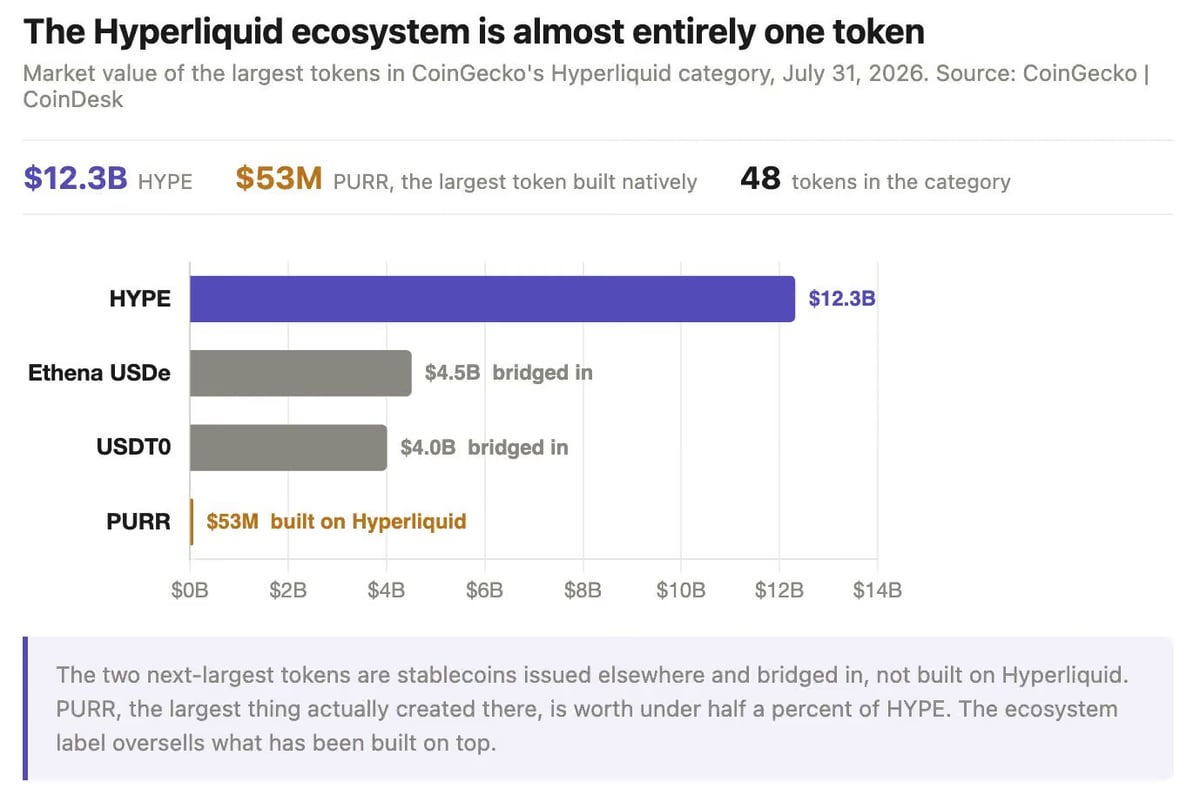
According to Dune’s Hyperliquid analytics, approximately 44.5 million HYPE has been removed from supply through the mechanism so far.
But because the buyback is linked to platform earnings, lower retained revenue also means less money available for token purchases.
The Assistance Fund bought roughly $290 million of HYPE in Q3 2025.
By Q2 2026, that figure had fallen to approximately $149 million.
This creates an important connection between Hyperliquid's business performance and HYPE's token economics.
HYPE price remains under pressure
HYPE traded near $55, down around 5% over the week and approximately 28% below its June record near $77.
The decline comes despite Hyperliquid maintaining high levels of trading activity.
The token's valuation therefore remains closely tied to expectations surrounding future protocol revenue, buybacks and ecosystem growth.
That dependence becomes more important as the platform expands beyond traditional crypto perpetuals.
Token unlocks add another source of pressure
HYPE also faces additional supply from scheduled token unlocks.
Nearly 10 million HYPE was unlocked for core contributors on Aug. 6, representing approximately $550 million at recent prices.
Additional unlocks are scheduled through 2027.
With a circulating supply of roughly 222 million HYPE, large monthly unlocks can create additional selling pressure if recipients choose to sell or hedge their allocations.
The interaction between new token supply and shrinking buyback capacity could become an important factor for HYPE's valuation.
Regulatory pressure continues
Hyperliquid is also facing increasing attention from regulators.
Singapore's Monetary Authority added the platform to its investor alert list in June, while regulators in other jurisdictions have raised questions around perpetual futures products.
The growing popularity of tokenized stock and commodity derivatives could bring additional scrutiny because these products combine characteristics of crypto derivatives with exposure to traditional financial assets.
For Hyperliquid, maintaining growth while navigating regulatory requirements could become increasingly important as RWA markets represent a larger portion of total activity.
Competition for on-chain trading is increasing
Hyperliquid is also facing competition from newer blockchain-based trading venues.
Robinhood Chain, for example, has rapidly expanded activity around tokenized assets and decentralized trading.
The broader trend suggests that the market for on-chain financial products is becoming increasingly competitive.
Hyperliquid's advantage remains its established perpetual futures infrastructure and growing liquidity, but competitors are beginning to target the same demand for 24/7 access to financial markets.
Hyperliquid's growth comes with a trade-off
Hyperliquid is not necessarily facing a business crisis.
The platform continues to process billions of dollars in trading activity and has become one of the largest venues for on-chain perpetual futures.
The challenge is that growth in trading volume is increasingly being shared with the builders creating that activity.
RWA perpetuals have become a major source of demand, but the HIP-3 model means external builders can retain a significant portion of the associated fees.
That creates a trade-off: Hyperliquid can expand its product range and attract more traders without building every market internally, but it captures a smaller percentage of the economic value generated by those markets.
For HYPE holders, that distinction matters because protocol earnings help fund the token's buyback mechanism.
If RWA perpetuals continue expanding while Hyperliquid's retained revenue keeps declining, the platform could process increasingly large volumes without generating proportional support for HYPE.
For now, Hyperliquid's record activity remains a major strength. The bigger question is whether that activity can translate into sustainable protocol revenue as builders capture a growing share of the fees.