Bitcoin and traditional markets are showing unusually low volatility despite U.S.-Iran tensions, rising sovereign debt and lingering crypto-specific risks, raising questions about how long the calm can last.
Markets appear remarkably calm despite a growing list of potential catalysts for volatility.
U.S.-Iran tensions remain elevated, sovereign debt continues to climb and bond yields are rising. In crypto, investors are also dealing with regulatory setbacks, uneven demand and a steady stream of security incidents.
Yet bitcoin, stocks, bonds, gold and oil are all showing relatively subdued expected volatility.
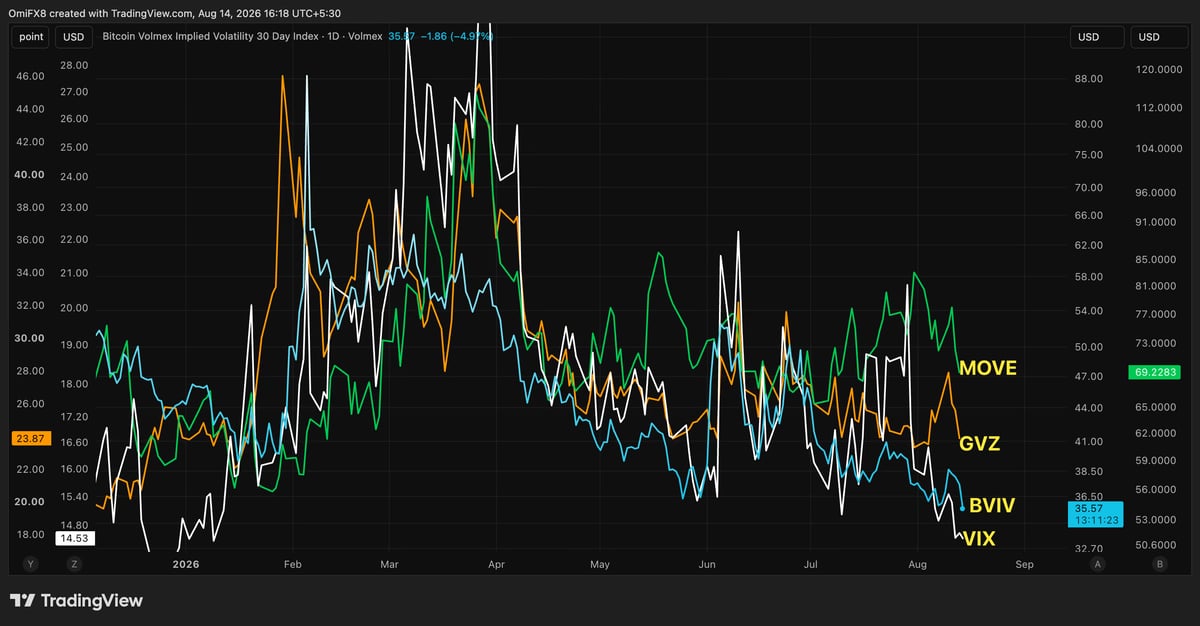
For Bitcoin, the clearest signal comes from the 30-day Bitcoin Volatility Index (BVIV), which has fallen back toward a 2026 low near 36%, according to TradingView data. The index briefly climbed toward 38% earlier this week before reversing lower.
The decline suggests options markets are pricing in less near-term turbulence even as several macroeconomic risks remain unresolved.
Bitcoin volatility returns to 2026 low
BVIV measures the market's expected 30-day volatility for Bitcoin based on options pricing. When implied volatility falls, traders are generally paying less for protection against large price swings.
Bitcoin's latest decline in implied volatility is particularly notable because it comes after a period of regulatory and macroeconomic uncertainty.
Ether has followed a similar trend, while volatility across major traditional asset classes has also declined.
The VIX, which tracks expected volatility for the S&P 500, has fallen to its lowest level since January. Meanwhile, the MOVE index, which measures expected volatility in U.S. Treasury markets, remains toward the lower end of its recent range.
Gold volatility has also weakened.
Together, the moves point to a broad-based reduction in hedging demand across financial markets.
Macro risks haven't disappeared
The decline in volatility does not mean the underlying risks have gone away.
U.S.-Iran tensions remain an important source of uncertainty for energy markets and global risk sentiment. Treasury yields have also moved higher, with the 10-year U.S. Treasury yield recently around 4.66%, while the 30-year yield moved above 5.2%.
Higher government borrowing costs can influence everything from equity valuations to cryptocurrency liquidity.
Bitcoin is particularly sensitive to changes in global liquidity and expectations for U.S. monetary policy. A sudden repricing of interest-rate expectations could therefore produce a sharp move even if current options markets remain relatively relaxed.
Recent U.S. inflation data also failed to create a major catalyst for Bitcoin. July consumer inflation came broadly in line with expectations, leaving traders focused on upcoming economic data and Federal Reserve policy signals.
Low volatility could mean calm — or complacency
There are two ways to interpret the synchronized decline in volatility.
From an efficient-market perspective, options markets are simply reflecting the information currently available to investors. If traders are not paying heavily for protection, the market may genuinely expect relatively stable conditions.
A contrarian interpretation is different.
When volatility reaches unusually low levels across several asset classes at the same time, markets can become vulnerable to a sudden repricing. A geopolitical escalation, unexpected economic data or a sharp move in Treasury yields could quickly push volatility higher.
The key issue is therefore not whether volatility is low, but how much risk is being priced out while potential catalysts remain unresolved.
Bitcoin faces its own set of risks
Crypto markets have additional sources of uncertainty beyond the macro environment.
Regulatory developments in the United States have recently disappointed some market participants, while demand across parts of the digital-asset market remains uneven.
Security incidents and hacks also continue to represent a structural risk for the industry.
At the same time, Bitcoin remains closely connected to broader financial markets. A sharp rise in Treasury volatility could tighten financial conditions and trigger risk reduction across equities and digital assets.
That makes the MOVE index an important indicator to watch alongside BVIV and VIX.
What Bitcoin traders should watch next
The current market setup suggests that volatility itself could become the next Bitcoin catalyst.
With BVIV near its 2026 low, the market is pricing relatively limited short-term turbulence. A sustained move higher in BVIV could therefore signal that traders are beginning to hedge against a larger Bitcoin move.
The same applies to VIX and MOVE.
If volatility remains suppressed, Bitcoin could continue trading within a relatively narrow range. But if geopolitical tensions intensify, Treasury yields rise sharply or incoming U.S. economic data changes expectations for Federal Reserve policy, the current calm could disappear quickly.
For now, the message from derivatives markets is clear: investors are pricing calm even though the list of potential risks remains long.
The next major move in Bitcoin may therefore come not from a known catalyst, but from a surprise that forces traders to rapidly reprice risk.
Bottom line
Bitcoin's 30-day implied volatility has returned to around 36%, near its lowest level of 2026, while volatility across stocks, Treasuries and gold is also declining.
The synchronized calm suggests investors are not aggressively pricing near-term shocks. But with geopolitical tensions, elevated Treasury yields and crypto-specific risks still present, the unusually low volatility could also leave markets vulnerable to a sudden reversal.
For BTC traders, BVIV, VIX and MOVE are worth watching closely.