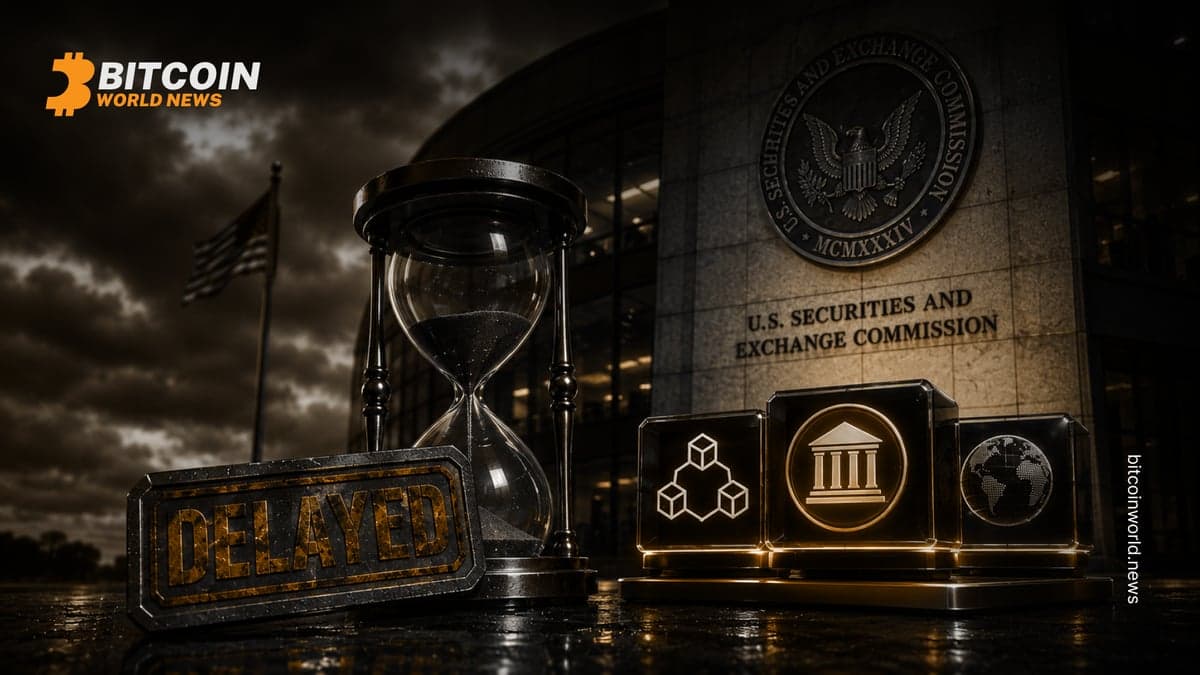
However, concerns from policymakers, Wall Street firms and SEC staff have reportedly slowed the initiative.
The delay comes shortly after the SEC canceled an Aug. 14 open meeting that had been expected to advance its separate “Regulation Crypto” proposal. The SEC's official notice confirms that the meeting was canceled without providing a new date.
SEC Tokenization Plans Face New Questions
The innovation exemption is intended to reduce some of the regulatory barriers surrounding blockchain-based securities.
Under the concept being considered, eligible firms could potentially issue or trade tokenized versions of traditional securities without navigating every aspect of the existing market structure in the same way as conventional securities venues.
That could make it easier to bring assets such as stocks, bonds and investment funds on-chain.
However, the proposal has raised questions about how tokenized securities would interact with established U.S. securities regulations.
One of the biggest issues involves how blockchain-based trading platforms would operate alongside traditional exchanges, broker-dealers and other market participants.
Wall Street Raises Market-Structure Concerns
Traditional financial institutions have also expressed concerns about the proposed approach.
The Securities Industry and Financial Markets Association, or SIFMA, has argued that significant changes to U.S. securities-market structure should go through a formal regulatory process rather than being introduced primarily through exemptions or no-action relief.
In a June 30 letter to the SEC, SIFMA requested that major structural changes involving tokenized equities and digital assets be addressed through an open and transparent process that allows market participants to provide comments.
The concern is particularly relevant to best-execution requirements.
Traditional U.S. securities markets operate under a framework designed to connect prices across regulated trading venues.
Tokenized assets could instead trade across a mixture of centralized platforms, blockchain networks and potentially decentralized systems.
That creates questions about how brokers would determine the best available execution price when blockchain-based venues use different liquidity and settlement models.
Regulation NMS Could Become More Important
One of the existing frameworks at the center of the discussion is Regulation NMS, which governs important parts of U.S. equity-market structure.
The SEC's Regulation NMS framework includes rules designed to promote efficient and competitive trading across U.S. securities markets.
Tokenized securities could challenge some assumptions behind that framework.
For example, decentralized exchanges and automated market makers can use fundamentally different mechanisms for price discovery and trade execution than traditional stock exchanges.
That raises a broader question for regulators:
Should tokenized securities operate entirely under existing market rules, or should the U.S. create specialized rules for blockchain-based markets?
The answer could significantly influence how quickly Wall Street adopts tokenization.
SEC Has Already Taken Steps on Market Structure
The SEC has already been examining parts of the existing market structure that could affect tokenized assets.
In June, the agency proposed changes involving Rule 611 of Regulation NMS, commonly known as the Order Protection Rule. The proposal would rescind Rule 611 and make related changes to Regulation NMS.
Changes like these could eventually make it easier to develop alternative trading structures.
However, the broader regulatory question remains unresolved.
Tokenized securities still need to fit within rules covering exchanges, broker-dealers, custody, settlement, investor protection and market transparency.
White House and Congress Add Another Layer
The SEC's timing is also being affected by broader U.S. crypto legislation.
Congress is working on the Digital Asset Market CLARITY Act, which could establish a broader regulatory framework for digital assets and clarify the responsibilities of U.S. regulators.
That creates a potential overlap between congressional legislation and SEC rulemaking.
If Congress establishes new statutory requirements while the SEC simultaneously introduces a tokenization exemption, the agency could potentially have to revise its approach.
For regulators, waiting for greater clarity from Congress could therefore reduce the risk of creating rules that quickly become outdated.
Innovation Exemption Has Already Been Delayed
This is not the first time the SEC has postponed the initiative.
The agency had previously been expected to release an innovation exemption earlier in 2026.
One major point of debate involved whether the framework could cover synthetic versions of securities rather than only blockchain-based representations of existing securities.
That distinction is important.
A token representing an actual underlying stock held with a custodian is structurally different from a token that provides economic exposure to a stock without the issuer or custodian holding the corresponding security.
The SEC's eventual approach could determine which models are permitted.
Tokenized Securities Are Becoming a Major Crypto Trend
Despite the regulatory uncertainty, tokenization has rapidly become one of the most important areas connecting crypto and traditional finance.
Financial institutions are exploring blockchain-based versions of:
Stocks
Government bonds
Money-market funds
Private credit
Investment funds
Other real-world assets
The appeal is largely connected to the potential benefits of blockchain-based settlement.
Tokenized assets could potentially enable faster settlement, programmable transactions, fractional ownership and around-the-clock market access, depending on the structure and regulatory framework.
That has attracted major financial institutions and market infrastructure providers.
Wall Street Is Moving Toward Tokenization
The interest is no longer limited to crypto-native companies.
Major U.S. financial-market institutions have begun exploring blockchain-based securities infrastructure.
The Depository Trust & Clearing Corporation (DTCC), one of the most important pieces of U.S. financial-market infrastructure, has been developing initiatives around tokenized securities and blockchain settlement.
The DTCC has also been working with market participants on its Digital Securities Management platform, which is designed to support tokenized securities and related market infrastructure.
Meanwhile, major exchanges and financial institutions are also investigating how traditional securities could move onto blockchain networks.
This suggests that tokenization is increasingly being treated as a potential evolution of financial-market infrastructure rather than simply another crypto use case.
Tokenization Could Become a Trillion-Dollar Market
The potential size of the market is one reason the SEC's approach matters so much.
Financial institutions increasingly view tokenization as a way to modernize settlement and expand access to traditionally fragmented financial markets.
If the technology becomes widely adopted, tokenized assets could eventually represent trillions of dollars in financial value.
That would make the regulatory framework governing these assets one of the most consequential developments for both crypto and traditional finance.
What the SEC Delay Means for Crypto
For the cryptocurrency industry, the latest delay creates another period of uncertainty.
Companies building tokenized securities platforms now have to wait longer to understand exactly how the SEC intends to structure its regulatory approach.
The delay could also give Congress more time to advance broader digital asset legislation.
At the same time, financial institutions are unlikely to completely stop experimenting with tokenization.
The technology is already being tested across several areas of financial infrastructure, meaning development is likely to continue even while regulators debate the appropriate framework.
SEC's Tokenization Decision Could Shape U.S. Crypto Markets
The SEC's eventual innovation exemption could have a significant impact on the future of blockchain-based financial markets in the United States.
A flexible framework could encourage financial institutions to move more assets on-chain and give crypto companies a clearer path into regulated markets.
A restrictive framework, by contrast, could push some tokenization activity toward offshore jurisdictions or alternative regulatory structures.
For Bitcoin and the broader digital asset industry, the outcome matters because tokenization is increasingly becoming part of the larger blockchain adoption story.
The SEC's latest delay does not signal the end of its tokenization plans, but it shows that the agency still faces major legal, political and market-structure questions before it can establish a durable framework for blockchain-based securities.