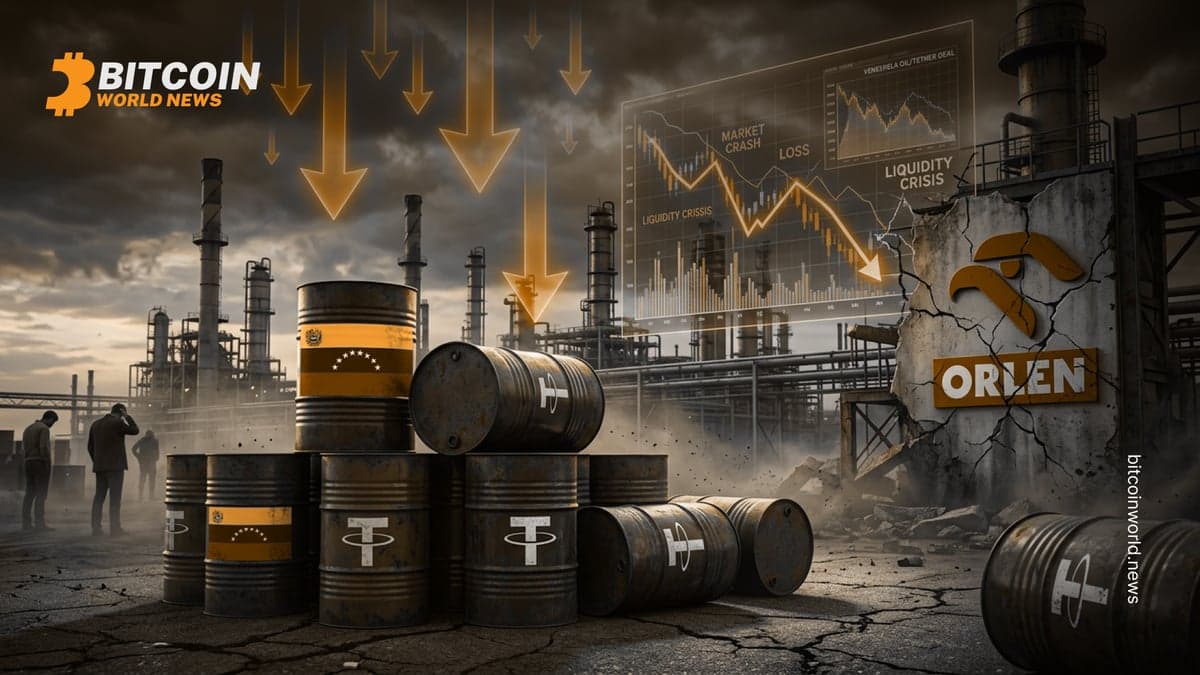
Tether Deal Triggers $230M Venezuelan Oil Loss at Orlen
Tether (USDT) payments tied to discounted Venezuelan crude left Poland’s state-controlled Orlen facing losses of up to $424 million in late 2023, after a covert crypto-based procurement plan unraveled. The episode matters for energy traders and crypto risk controls as $230 million allegedly vanished via USB drives.
Tether (USDT) was at the center of a covert crude procurement that left Poland’s state-controlled energy company Orlen facing losses of up to $424 million, with $230 million in cryptocurrency tied to Venezuelan oil allegedly vanishing on USB drives. The late-2023 deal aimed to secure discounted barrels outside traditional banking rails.
The plan took shape in late November 2023 in Abu Dhabi, where Samer Awad, then head of Orlen Trading Switzerland (OTS), met Kam Ho “Alex” Tse to pursue tether-based payments for Venezuelan crude. What began as an attempt to bypass financial friction has since widened into one of the nation’s largest corporate and political scandals.
How did a tether-funded oil trade go missing?
The venture relied on USDT transfers and offline custody to settle Venezuelan crude purchases, a setup that exposed funds to operational and counterparty risk. As the scheme unraveled, $230 million in cryptocurrency allegedly disappeared on USB drives, and Orlen now faces losses that could reach $424 million from the failed arrangement.
Sponsored
By moving payments off traditional correspondent banking and into stablecoin rails, Orlen sought speed and access to discounted supply. But using removable media for key storage and transaction authorization created fragility at the most sensitive point in the flow of funds. Without robust multi-signature controls, auditable custody, or institutional-grade wallet infrastructure, recovery prospects diminished as soon as control of the devices lapsed.
The Abu Dhabi meetings in late November 2023 linked Orlen’s trading arm to intermediaries positioned to facilitate the unconventional settlement. As market conditions tightened and counterparties probed compliance constraints, the operational chain supporting USDT transfers proved brittle, culminating in funds that could not be traced through standard banking reconciliation.
Milestone
Date/Place
Parties
Amount
Deal framework for discounted Venezuelan crude
Late Nov 2023, Abu Dhabi
OTS led by Samer Awad; Kam Ho “Alex” Tse
N/A
Stablecoin settlement via USDT and offline storage
2023
Orlen Trading Switzerland (OTS)
$230M in crypto allegedly lost
Total exposure from failed arrangement
2023
Orlen
Up to $424M
Why does this matter for crypto and commodity trading risk?
The collapse exposes the limits of ad hoc crypto custody and the dangers of removable-media key storage in high-value trades. Large-dollar commodity settlements demand institutional wallet controls, auditable on-chain workflows, and clear counterparty accountability—requirements that were not met here, forcing Orlen to grapple with up to $424 million in losses tied to a $230 million USDT shortfall.
Energy merchants and corporate treasurers exploring cryptocurrency settlement can draw a stark lesson: stablecoins reduce payment friction but do not eliminate the need for rigorous governance. When funds rest on USB drives instead of in policy-enforced, segregated wallets with multi-factor authorization and recovery procedures, operational risk becomes the dominant variable in transaction success.
The alleged disappearance of funds also underscores how quickly assets can become unrecoverable without chain-of-custody documentation and independent oversight. Even with USDT’s dollar peg and deep liquidity, inadequate processes can strand capital outside the safeguards built into regulated banking channels.
What happens next for Orlen and counterparties?
The fallout is likely to focus on tracing flows connected to the late November 2023 Abu Dhabi meetings, scrutinizing the roles of Orlen Trading Switzerland leadership and intermediaries including Kam Ho “Alex” Tse. Any recovery path hinges on identifying custody points for the $230 million in USDT and reconciling exposure that could total $424 million.
Internally, Orlen faces a reassessment of trading controls and crypto custody standards. Externally, counterparties tied to Venezuelan crude arrangements may confront heightened due diligence and tightened settlement protocols. For market participants watching stablecoin adoption, the episode is a warning that payment rails cannot substitute for institutional-grade risk management.
As investigations progress, the central questions remain whether the missing USDT can be located and how Orlen contains financial and governance damage from one of Poland’s most consequential corporate setbacks in 2023.
This article is for informational purposes only and does not constitute financial, investment, or trading advice. Cryptocurrency markets are highly volatile and carry significant risk. Always conduct your own research (DYOR) and consult a qualified financial advisor before making investment decisions. Past performance does not guarantee future results.
Share
The crypto brief, in your inbox
BTC, markets, and the stories that moved crypto — daily, no noise.