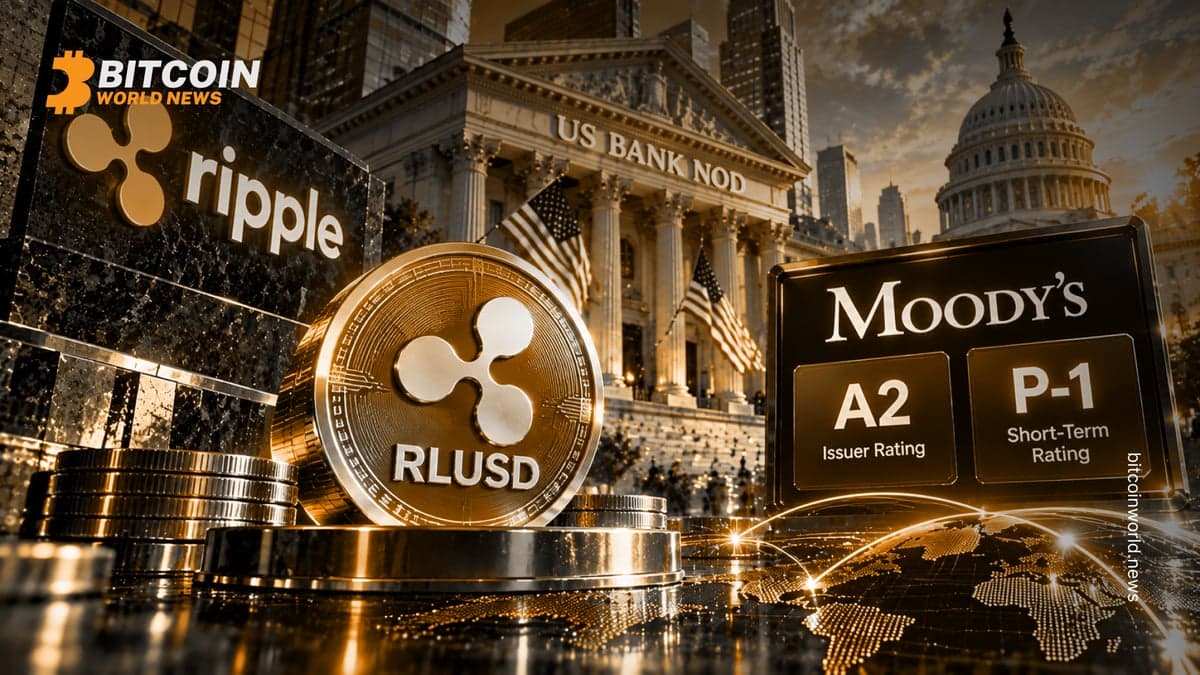
Ripple USD (RLUSD) secured investment-grade ratings from Moody’s on Oct. 27, a day after Ripple obtained final approval from the U.S. Office of the Comptroller of the Currency (OCC) to form Ripple National Trust Bank. Moody’s assigned RLUSD A2 long-term and P-1 short-term deposit ratings, evaluating the stablecoin’s backing and redemption framework.
The deposit ratings apply to RLUSD issued natively on the XRP Ledger and on Ethereum, with issuance handled by Standard Custody & Trust Company (SCTC), Ripple’s New York–regulated trust company. Ripple targets 103% reserve coverage for RLUSD, while the Moody’s assessment flags bankruptcy risks as a qualification.
Why did Moody’s assign investment-grade ratings to RLUSD?
Moody’s assigned A2 long-term and P-1 short-term deposit ratings to RLUSD based on its assessment of the stablecoin’s backing and redemption framework. The ratings apply to tokens issued by Standard Custody & Trust Company on both the XRP Ledger and Ethereum, reflecting structural features intended to support liquidity and redemption confidence.
The investment-grade designations arrive alongside Ripple’s stated target of 103% reserve coverage, a buffer above parity designed to reinforce stability. Moody’s also noted bankruptcy risks as a qualification in its assessment, underscoring that governance, custody, and legal structures remain critical to stablecoin performance through stress conditions. The dual-network issuance broadens distribution while maintaining a common reserve and redemption standard under SCTC’s trust company oversight.
Date | Milestone |
|---|
Oct. 26 | Final approval for Ripple National Trust Bank from the OCC |
Oct. 27 | Moody’s assigns RLUSD A2 long-term and P-1 short-term deposit ratings |
What does U.S. bank approval change for Ripple?
The OCC’s final approval for Ripple National Trust Bank on Oct. 26 adds a regulated banking pillar to Ripple’s structure, arriving one day before the RLUSD ratings. The proximity of these milestones ties governance and oversight enhancements to the ratings event, strengthening the project’s institutional posture.
While the ratings focus on the stablecoin’s deposit characteristics and redemption mechanics, the bank’s approval signals additional regulatory scaffolding around Ripple’s broader financial infrastructure. Standard Custody & Trust Company remains the issuing trust for RLUSD on the XRP Ledger and Ethereum, aligning issuance with New York–regulated trust oversight. Combined, these steps frame RLUSD within a more formalized compliance environment, while Moody’s still highlights bankruptcy risks within its qualification language.
Ripple’s 103% reserve coverage target sits at the center of the framework under review. That over-collateralization goal aims to assure par redemptions even under routine liquidity demands, and the A2/P-1 designations indicate Moody’s view that the stablecoin’s structure supports timely repayment characteristics. The ratings therefore function as a public signal to counterparties assessing RLUSD’s risk profile across both networks.
What should investors and institutions watch next?
The key watchpoints are reserve maintenance against the 103% target, the consistency of redemptions on XRP Ledger and Ethereum, and any changes in the legal or custody setup flagged in Moody’s qualifications. Together, those factors will shape how the A2/P-1 designations hold through market cycles.
Monitoring disclosures from the issuing trust company and bank-related governance developments will be central to evaluating RLUSD’s resilience. The dual-chain issuance requires operational discipline to keep redemption mechanics uniform across networks, and bankruptcy risk qualification remains a reminder that legal structuring is as important as reserve composition. The back-to-back milestone dates—Oct. 26 for bank approval and Oct. 27 for Moody’s ratings—set a new baseline for how regulated trust structures, reserve targets, and third-party assessments can converge in stablecoin markets.
With investment-grade ratings now in place, subsequent steps will likely focus on maintaining reserve coverage and demonstrating durable redemption performance on both chains under varied liquidity conditions.