Ripple did not publicly identify the recipient or explain how the newly minted tokens would be used.
The issuance confirms that new RLUSD entered the ledger, but it does not by itself prove that institutional demand increased. The tokens could remain in controlled accounts until they are transferred to customers, exchanges, market makers or other counterparties.
RLUSD mint does not automatically mean new demand
A stablecoin mint represents the creation of new tokens, but the blockchain transaction alone does not reveal the commercial purpose behind the issuance.
New RLUSD can be created for several reasons, including customer settlement, liquidity management, treasury operations or preparation for future redemptions and transfers.
Ripple also completed another 10 million RLUSD mint on Aug. 10. That issuance occurred while the stablecoin's supply remained below earlier 2026 levels.
A separate community report from BankXRP also showed a 5 million RLUSD burn on Ethereum.
BankXRP's RLUSD burn report
A burn removes tokens from circulation and can occur when customers redeem stablecoins. However, available blockchain records do not establish whether the Ethereum burn was directly connected to the latest XRP Ledger mint.
That distinction matters because mints and burns can happen independently across different networks.
RLUSD supply climbs back toward $1.71 billion
Market data showed RLUSD's circulating supply at approximately 1.711 billion tokens on Aug. 17, placing its market capitalization around $1.71 billion.
RLUSD market data on CoinGecko
Reported 24-hour trading volume was around $50 million at the time of the latest market-data check, although both supply and trading volume can change throughout the day.
The latest circulating-supply figure was higher than Ripple's Aug. 6 transparency disclosure. Ripple's official transparency page reported approximately $1.5896 billion of RLUSD in circulation against around $1.7026 billion in reserve assets at that reporting date.
Ripple RLUSD transparency report
The two figures should not be compared as if they represent the same point in time. Reserve attestations provide historical snapshots, while blockchain activity continues between reporting dates.
As a result, subsequent mints and burns can materially change the circulating supply before the next formal reserve disclosure.
RLUSD supply has fluctuated throughout 2026
The latest issuance is also part of a broader pattern of RLUSD supply changes rather than a straight upward trajectory.
The Aug. 10 mint came after earlier burns reduced the amount of RLUSD in circulation. This makes individual mint transactions difficult to interpret in isolation.
A 10 million-token issuance increases the potential supply, but the longer-term trend depends on whether those tokens remain outstanding or are subsequently redeemed and burned.
For Bitcoin-focused investors, this distinction is important because stablecoin supply can sometimes be used as a proxy for available crypto liquidity, but a single mint should not automatically be interpreted as fresh capital entering Bitcoin or the broader digital-asset market.
RLUSD operates under New York regulatory oversight
RLUSD is issued by Standard Custody & Trust Company, which operates under a limited-purpose trust charter from the New York State Department of Financial Services.
Ripple says RLUSD is designed to maintain a 1:1 value with the U.S. dollar and is backed by segregated reserves consisting of assets such as cash, cash equivalents and short-term U.S. Treasury securities.
Ripple also states that its reserve holdings undergo monthly independent attestations.
The company's Aug. 6 disclosure showed reserve assets exceeding the amount of RLUSD reported as circulating at that time. However, that disclosure does not establish the exact reserve position when the Aug. 17 mint occurred.
The next monthly attestation should provide a more current comparison between outstanding RLUSD and the assets backing the stablecoin.
Ripple expands RLUSD access for institutions
Ripple has been building additional infrastructure around RLUSD as it seeks to increase institutional adoption.
The company launched Ripple Mint for approved institutional customers, allowing them to mint, redeem, bridge and monitor RLUSD through a dedicated platform.
Ripple says the platform can also support automated workflows for institutional customers.
Ripple Mint and RLUSD institutional infrastructure
The company has also expanded its partnerships around stablecoin compliance and payments infrastructure.
Ripple made an investment in Notabene, with the two companies planning to integrate RLUSD into Notabene Flow and explore connections between transaction authorization and Ripple Payments.
Notabene's announcement on Ripple's investment
RLUSD expands beyond the XRP Ledger
RLUSD is not limited to the XRP Ledger. The stablecoin has also expanded across other blockchain networks and into additional markets.
In Japan, Ripple and SBI introduced RLUSD through SBI VC Trade following regulatory approval, making the stablecoin available to eligible customers.
Ripple has also worked with BiLira, Bitexen and Bitlo to expand RLUSD access for institutional users in Türkiye.
These developments demonstrate Ripple's broader strategy of positioning RLUSD as an institutional settlement and payment asset rather than simply another trading stablecoin.
However, none of these partnerships confirms that the specific 10 million RLUSD minted on Aug. 17 was created for a particular customer.
What the latest RLUSD mint means for Bitcoin
For the broader crypto market, the key question is whether the increase in RLUSD supply eventually translates into additional liquidity across digital-asset markets.
Stablecoins are widely used as trading and settlement assets, meaning a growing supply can potentially provide more capital for exchanges, market makers and institutional transactions.
But the latest transaction should not be treated as evidence that $10 million of fresh money entered Bitcoin.
The blockchain confirms that 10 million RLUSD tokens were minted. It does not reveal whether the tokens came from a new customer deposit, internal liquidity management, an upcoming settlement or another operational purpose.
Future transfers from the destination wallet could provide additional clues about where the tokens are going, although the identity of the underlying customer may remain private.
What happens next for RLUSD
The next important indicators will be RLUSD transfers, additional mints and burns, and Ripple's next reserve disclosure.
If the newly issued tokens remain outstanding and additional issuance continues to exceed redemptions, RLUSD's circulating supply could continue expanding.
Conversely, large burns could indicate that newly created supply is being redeemed or rebalanced.
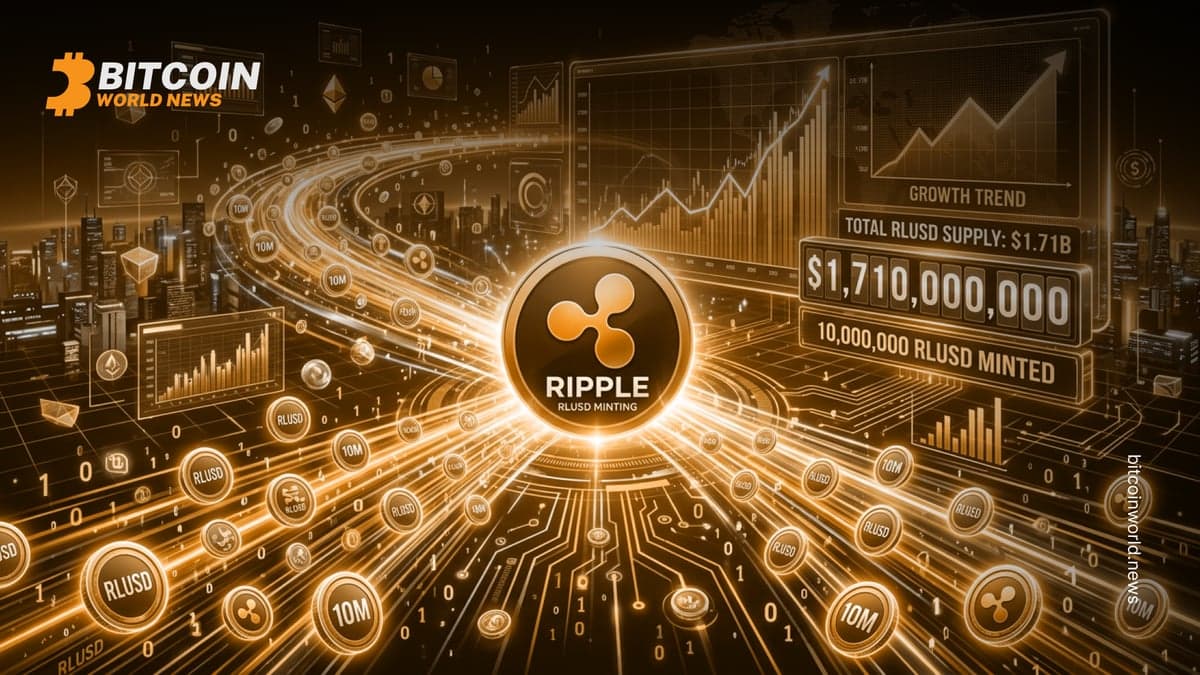
For now, the confirmed data are straightforward: Ripple minted 10 million RLUSD on the XRP Ledger on Aug. 17, while total circulating supply reached roughly 1.71 billion tokens.
The transaction shows continued activity around Ripple's stablecoin, but the public blockchain record does not independently prove that institutional demand increased or that new capital flowed into Bitcoin.