Crypto Payments Remain Rare Among Businesses
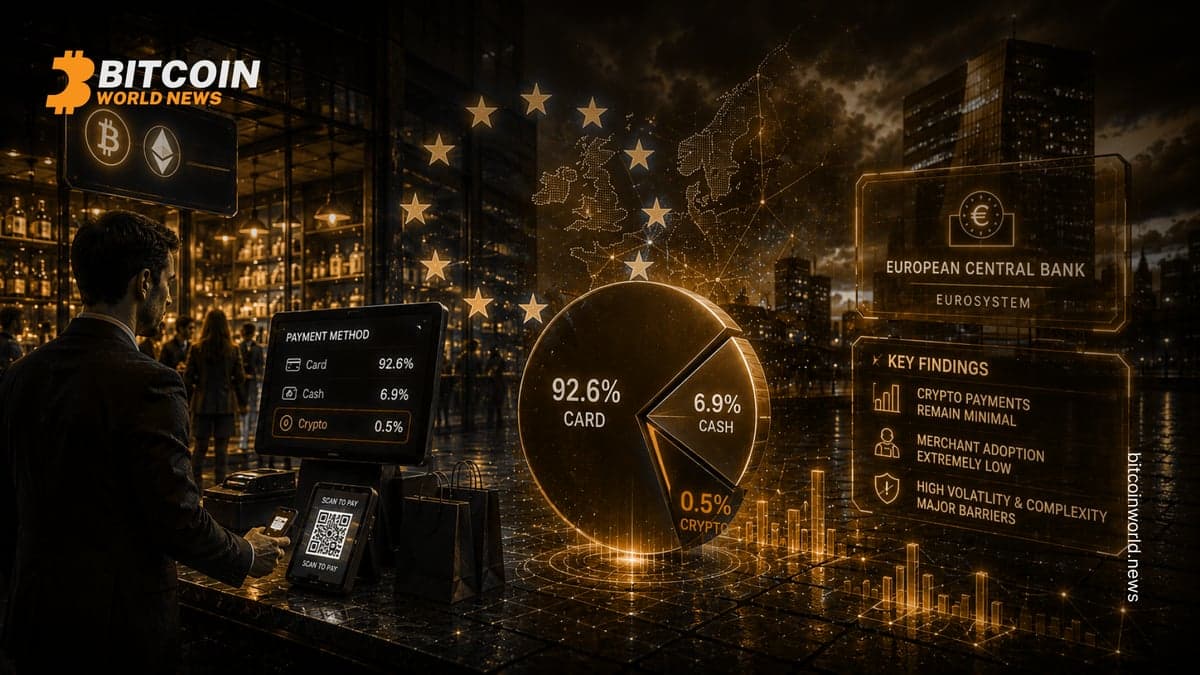
The ECB found that only 0.2% of companies selling goods and services online accept crypto assets.
The survey covered 8,205 businesses across 21 euro area countries, including retailers, restaurants and cafes, hotels, and companies operating in the arts, entertainment and recreation sectors.
The research was conducted by Ipsos between Feb. 23 and April 10, providing a broad snapshot of how businesses currently use and accept different payment methods.
Despite the growth of cryptocurrencies and stablecoins in financial markets, their use for everyday merchant payments remains extremely limited.
Cash Remains the Most Widely Accepted Payment Method
Cash continues to dominate among businesses with physical points of sale.
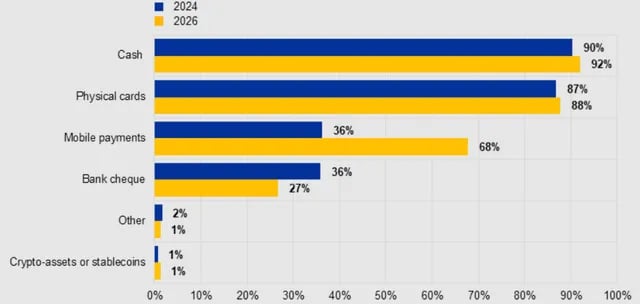
Approximately 92% of surveyed companies said they accept cash, up from 90% in the ECB's previous 2024 survey.
Physical cards were accepted by 88% of businesses, compared with 87% two years earlier.
The continued popularity of cash shows that traditional payment methods remain deeply embedded in the euro area's retail economy, even as digital alternatives expand.
The ECB's full survey provides additional details on how merchants across the euro area are adapting their payment options. ECB — Study on the use of cash by companies in the euro area
Mobile Payments Are Growing Rapidly
Mobile payments recorded the biggest increase among payment methods accepted at physical locations.
The percentage of businesses accepting mobile payments jumped to 68% in 2026 from 36% in 2024.
The category includes instant-payment solutions and digital wallets such as Apple Pay and Google Pay.
The sharp increase suggests that merchants are increasingly comfortable accepting payments through smartphones and digital wallets, even though crypto-based payments have yet to achieve similar adoption.
This creates an important contrast within the digital payments market: mobile payments are becoming mainstream, while crypto payments remain niche.
Crypto and Stablecoin Acceptance Remains Below 1%
The ECB found little change in the acceptance of crypto assets and stablecoins at physical points of sale.
Acceptance remained below 1% in both 2024 and 2026, indicating that cryptocurrencies have made limited progress as a merchant payment method.
This is notable given the rapid expansion of stablecoins in other parts of the financial system.
Stablecoins such as USD-pegged digital assets are increasingly used for trading, transfers and settlement, but the ECB's data suggests that this activity has not translated into widespread merchant acceptance across the euro area.
Consumer Preference Drives Payment Choices
For businesses, consumer demand remains the most important factor when deciding which payment methods to accept.
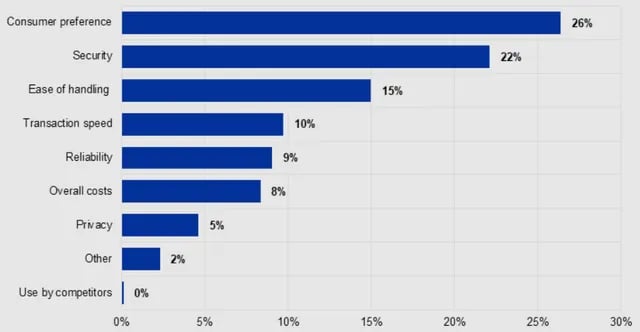
Consumer preference was cited by 26% of respondents as the main consideration.
Security followed at 22%, while ease of handling was cited by 15% of companies.
The results suggest that merchants are primarily responding to what their customers already want to use rather than adopting payment technologies simply because they are technologically available.
This could help explain why mobile wallets have expanded much faster than cryptocurrency payments.
Why Businesses Reject Cash
The ECB also examined why some businesses choose not to accept cash.
Among companies that do not accept cash, 36% cited weak customer demand, while 35% pointed to difficulties depositing or withdrawing cash.
Another 29% identified security risks as a reason for rejecting cash payments.
These findings show that merchants are weighing convenience, customer behavior and operational considerations when determining which payment methods to support.
Digital Euro Could Change the Payment Landscape
The findings arrive as the ECB continues developing the potential digital euro, a central bank digital currency intended to complement cash and existing electronic payment methods.
Unlike privately issued cryptocurrencies and stablecoins, a digital euro would be issued within the euro area's central-bank monetary framework.
The ECB has said the digital euro project is intended to provide Europeans with a digital form of central bank money that can be used for everyday payments.
The central bank is continuing technical and regulatory preparations for the potential launch of the digital euro. ECB — Digital euro project
Digital Payments Are Taking Different Paths
The ECB's findings highlight an important difference between cryptocurrency adoption and broader digital-payment adoption.
Mobile payments have expanded dramatically, with merchant acceptance nearly doubling since 2024.
Crypto payments, by contrast, remain at extremely low levels.
The difference may partly reflect the fact that mobile wallets generally operate through existing banking and card infrastructure, allowing consumers to use familiar payment methods through smartphones.
Crypto payments can involve additional issues such as price volatility, tax treatment, accounting requirements and payment settlement preferences.
What Counts as Crypto Payment Acceptance?
The ECB survey asked businesses whether they accept crypto assets or stablecoins, specifically citing Bitcoin, Ether and Tether's USDt as examples.
However, the survey also highlights an important complication.
Some cryptocurrency payment providers allow customers to pay with crypto while merchants ultimately receive settlement in traditional fiat currency.
It is not clear from the survey whether businesses using those services would classify themselves as accepting crypto payments.
That distinction could affect how cryptocurrency adoption among merchants is measured.
Crypto Adoption Remains Limited
The survey provides a useful reality check for the broader cryptocurrency industry.
While crypto assets have gained significant traction as investment products and stablecoins have become important within digital-asset markets, their use for everyday purchases remains limited across the euro area.
For merchants, payment adoption appears to be driven primarily by customer demand, security and ease of use.
Until cryptocurrency payments can offer comparable convenience and demand, widespread merchant adoption may remain difficult to achieve.
Europe’s Payment Market Is Becoming More Digital
The broader direction of travel is nevertheless clear: Europe's payment ecosystem is becoming increasingly digital.
Mobile payment acceptance has surged, digital wallets are becoming more common and the ECB is developing infrastructure for a potential digital euro.
At the same time, cash remains highly relevant, with more than nine in 10 businesses with physical locations continuing to accept it.
Crypto therefore represents only a small part of a much larger transformation taking place in the European payments market.
Conclusion
Crypto payments remain a niche option among euro area merchants, with just 0.2% of businesses selling goods and services online reporting that they accept crypto assets.
The contrast with mobile payments is significant. Mobile payment acceptance at physical locations jumped from 36% in 2024 to 68% in 2026, while crypto and stablecoin acceptance remained below 1%.
The findings suggest that cryptocurrencies have yet to become a mainstream merchant payment method in the euro area, even as digital payments continue to expand.
With the ECB's digital euro project progressing alongside the rapid growth of mobile payments, the European payments landscape is likely to become increasingly digital — but crypto remains a relatively small part of that transition.