BlackRock Lowers Bitcoin ETF Swap Minimum to $1 Million
BlackRock has reportedly reduced the minimum amount of Bitcoin required for large holders to swap BTC directly into shares of its iShares Bitcoin Trust ETF (IBIT), lowering the threshold from $25 million to $1 million.
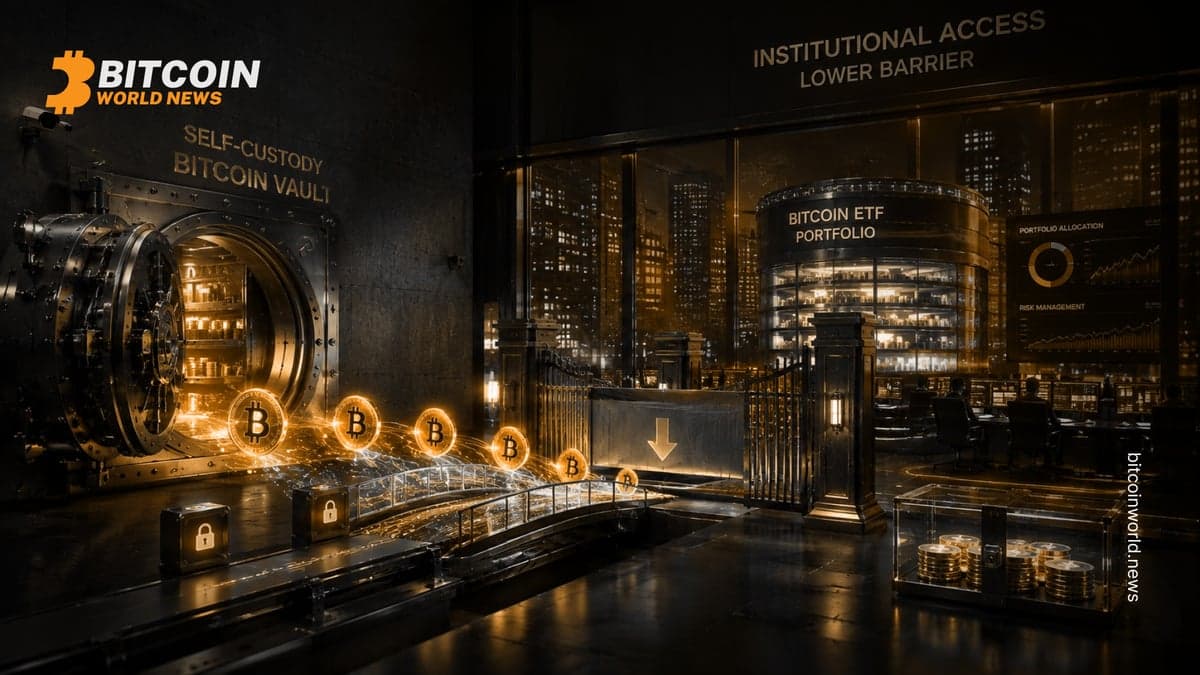
The change could make it significantly easier for Bitcoin whales and institutional investors to move part of their holdings from self-custody into a regulated spot Bitcoin ETF structure.
BlackRock's iShares Bitcoin Trust ETF provides investors with exposure to Bitcoin through an exchange-traded product while reducing some of the operational and custody requirements associated with holding BTC directly.
Bitcoin Swap Threshold Falls From $25 Million to $1 Million
According to a Bloomberg report, BlackRock reduced the minimum value required for direct Bitcoin-to-IBIT swaps to approximately $1 million in July, compared with the previous $25 million threshold.
Bitwise has reportedly made a similar move, lowering its minimum from approximately $100 million to $3 million.
The changes suggest that ETF issuers are attempting to make the transition from direct Bitcoin ownership to traditional investment vehicles more accessible to a broader group of large holders.
For institutional investors, the lower thresholds could remove one of the barriers that previously made direct ETF creation impractical for smaller large-scale transactions.
How In-Kind Bitcoin ETF Creation Works
The process is known as in-kind creation.
Instead of selling Bitcoin for cash and then purchasing ETF shares, an investor or authorized participant can deliver Bitcoin directly to the fund in exchange for newly created ETF shares.
This structure can simplify the transition from direct BTC ownership into an ETF without requiring the underlying Bitcoin to be sold on the open market.
The U.S. Securities and Exchange Commission approved in-kind creations and redemptions for crypto exchange-traded products in July 2025, allowing Bitcoin and Ether ETPs to use the mechanism under approved orders.
Why Bitcoin Whales Are Moving Toward ETFs
Large Bitcoin holders face a range of risks when keeping assets in self-custody.
Private-key management, security procedures, physical custody arrangements and exposure to theft can all become increasingly complicated as the value of a Bitcoin treasury grows.
BlackRock's head of digital assets, Robbie Mitchnick, said crypto-related kidnappings, hacks and custody failures are among the events motivating some holders to reconsider how they store their Bitcoin.
For some investors, moving a portion of their holdings into an ETF can provide a more traditional custody structure while maintaining exposure to Bitcoin's price.
IBIT Has Processed Billions in Bitcoin Swaps
The shift toward in-kind transactions is already significant.
According to the report, IBIT has processed more than $5 billion through these swaps, compared with approximately $3 billion in October.
The growth illustrates how Bitcoin ETFs are increasingly becoming an alternative route for large holders seeking exposure through traditional financial infrastructure.
BlackRock's IBIT has also grown into a major Bitcoin investment vehicle. The fund's official data shows that it trades on Nasdaq and is designed to track the price of Bitcoin.
Bitwise Also Lowers Its Bitcoin ETF Barrier
BlackRock is not alone in reducing the threshold.
Bitwise has reportedly lowered the minimum size for similar Bitcoin ETF transactions to approximately $3 million from $100 million.
The change could make in-kind ETF creation more practical for a wider range of institutional investors, family offices and large Bitcoin holders.
Bitwise's official Bitcoin investment materials describe its products as providing Bitcoin exposure through traditional investment structures while reducing logistical barriers such as exchange access, custody and execution.
Bitcoin ETF Adoption Moves Beyond Retail Investors
The development highlights an important evolution in the Bitcoin ETF market.
When spot Bitcoin ETFs launched, much of the attention focused on traditional investors gaining an easy way to obtain BTC exposure through brokerage accounts.
The next phase is increasingly about large Bitcoin holders moving in the opposite direction: taking Bitcoin already held directly and converting it into ETF shares.
That creates a bridge between the crypto-native world of self-custody and the traditional financial system.
Crypto Crime Is Accelerating the Shift
Security concerns appear to be playing an increasingly important role in that transition.
Bitcoin holders with large balances can become attractive targets for hackers, thieves and physical criminals. A significant self-custody operation can also require sophisticated security procedures and multiple layers of operational controls.
ETF structures shift much of that responsibility toward established financial infrastructure.
That does not eliminate risk, but it changes the type of risk investors face from managing private keys themselves to relying on the fund, custodian and broader financial system.
Ethereum ETFs Are Following the Same Path
The trend is also expanding beyond Bitcoin.
ETF issuers including Grayscale and VanEck have introduced similar in-kind mechanisms for Ether products, showing that the development is becoming part of the broader crypto ETF ecosystem.
As more digital assets become available through regulated exchange-traded products, institutional investors may increasingly view ETFs as an alternative to maintaining large direct positions.
What Lower ETF Swap Minimums Mean for Bitcoin
The reduction in BlackRock's minimum from $25 million to $1 million represents a major change in accessibility for large Bitcoin holders.
A $25 million threshold restricted the mechanism to a relatively small group of whales and institutions. A $1 million threshold potentially brings the process within reach of many more professional investors.
The development could also strengthen the connection between Bitcoin's native market and Wall Street's ETF infrastructure.
For Bitcoin investors, the bigger story is not simply that BlackRock lowered a transaction threshold. It is that the financial system is becoming increasingly capable of absorbing Bitcoin directly into traditional investment structures.
What Bitcoin Investors Should Watch Next
The key developments to monitor are further reductions in ETF creation minimums, additional adoption of in-kind transactions and continued growth in institutional Bitcoin ETF activity.
Investors should also watch whether other ETF issuers follow BlackRock and Bitwise by lowering their thresholds.
If that happens, the distinction between holding Bitcoin directly and holding Bitcoin through traditional financial products could become increasingly blurred.
For now, BlackRock's reported move from a $25 million minimum to $1 million signals another step in Bitcoin's migration from self-custodied crypto assets toward mainstream institutional financial infrastructure.