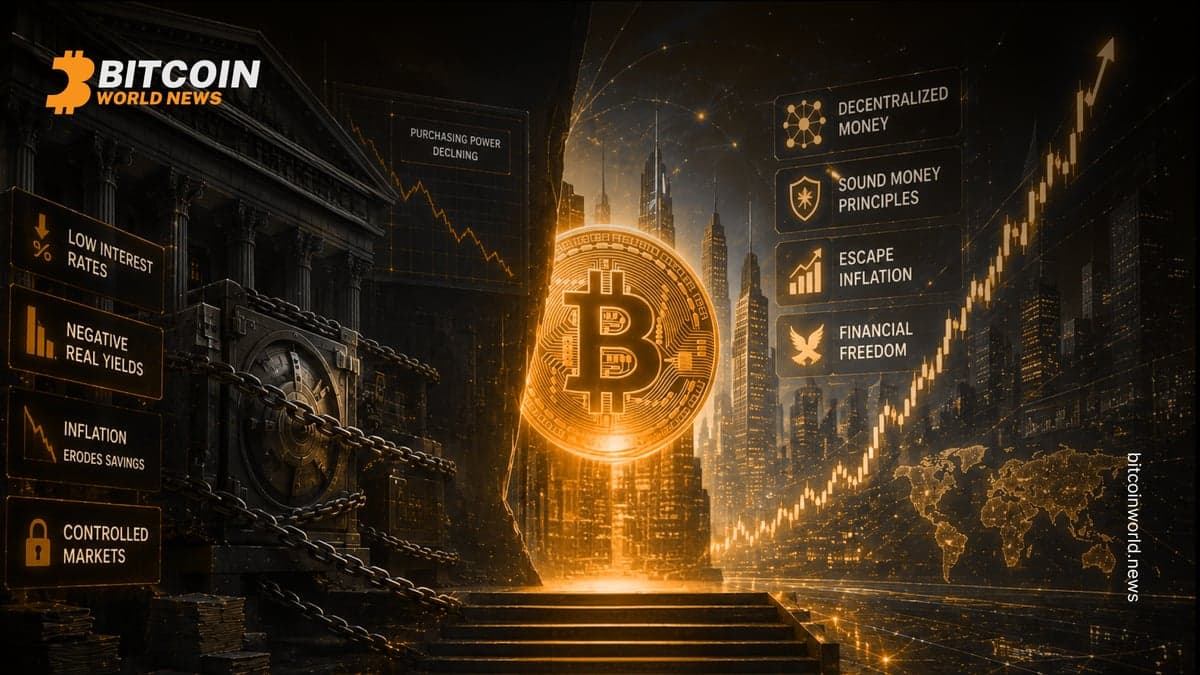
Financial Repression: Why Bitcoin Bulls Are Paying Attention
Financial repression is becoming a popular topic among Bitcoin investors as governments face rising debt burdens and look for ways to manage borrowing costs.
The concept describes policies that can reduce the real value of government debt by keeping interest rates below inflation, directing institutional savings toward government bonds or restricting where citizens can hold financial assets.
For Bitcoin bulls, the argument is straightforward: if savers increasingly lose purchasing power through traditional financial assets, demand could shift toward scarce alternatives such as Bitcoin and gold.
What Is Financial Repression?
Financial repression occurs when governments influence financial markets in ways that help reduce the real burden of public debt.
One common approach is keeping interest rates below the rate of inflation. When that happens, the purchasing power of money held in cash or low-yielding bonds declines over time. Governments can also encourage banks, pension funds and other institutions to hold government debt.
Another form involves restricting capital flows or limiting access to financial services outside a particular jurisdiction. These measures can reduce the ability of savers to move their money toward higher-yielding or foreign assets.
The result is effectively a transfer of wealth from savers and creditors toward heavily indebted governments.
Why Bitcoin Bulls Are Watching
Bitcoin bulls see financial repression as potentially bullish because BTC is not issued by a government and has a fixed maximum supply.
Unlike cash and government bonds, Bitcoin cannot be created to finance a government's debt. That makes it attractive to investors looking for assets that are less directly connected to monetary and fiscal policy.
This is similar to the argument behind Bitcoin as an inflation hedge, although Bitcoin's relatively short history and high volatility mean it does not behave like traditional inflation-protection assets in every market environment.
Gold plays a similar role in the financial-repression argument. Both assets can be viewed as alternatives to currencies and government debt when investors become increasingly concerned about purchasing power.
Europe Tightens the Financial Framework
Europe provides one example that has attracted attention from financial-repression watchers.
An EU banking rule will restrict certain banking activities by institutions based outside the bloc unless they establish an appropriately authorized branch within the relevant member state. The rules are part of the EU's broader framework governing access to banking services and cross-border financial activity.
The European Banking Authority's work on the banking framework is part of a wider effort to harmonize financial regulation across member states. (European Banking Authority)
Critics see restrictions on where financial services can be provided as potentially reducing the ability of savers to move assets freely across borders.
That does not automatically make the policy financial repression, but it illustrates why the term is increasingly appearing in discussions about capital mobility and government debt.
U.S. Treasury Buybacks Add to the Debate
The United States has also become part of the conversation following the Treasury's expanded bond-buyback operations.
The Treasury announced that the maximum size of certain long-term Treasury buyback operations would increase from $2 billion to at least $4 billion per operation. The program is designed primarily to improve liquidity in older Treasury securities. (U.S. Treasury)
Some analysts have described the move as a form of financial repression because it could help reduce pressure in the long-term bond market.
However, there is an important distinction: Treasury bond buybacks are not the same as Federal Reserve quantitative easing. Treasury buybacks are part of debt management, while QE involves purchases by the central bank.
The distinction matters because investors should not automatically interpret every bond-market intervention as monetary money printing.
Could Financial Repression Push Money Into Bitcoin?
The potential Bitcoin connection comes from investor behavior.
If governments keep real interest rates low while inflation remains elevated, traditional savings can become less attractive. Investors may then search for assets capable of preserving purchasing power.
Bitcoin could benefit from this shift, particularly if institutional adoption continues to grow through regulated investment products and custody infrastructure.
The same dynamic can benefit gold, which has a much longer history as a store of value. Recent strength in gold prices and the dollar-debasement trade has already highlighted how investors are responding to concerns surrounding government debt, currencies and bond markets.
Rising Government Debt Is the Bigger Story
The financial-repression debate ultimately comes back to government debt.
Debt-to-GDP ratios increased substantially across many developed economies after the pandemic. As governments face higher interest expenses, allowing market interest rates to remain significantly above inflation for extended periods can make debt servicing more expensive.
That creates a difficult policy trade-off.
Governments can pursue spending cuts, raise taxes, tolerate higher inflation, accept slower growth or attempt to keep borrowing costs manageable. Financial repression is one possible mechanism within that broader policy toolkit.
For Bitcoin investors, the important question is whether these pressures become persistent enough to change long-term capital allocation.
What Bitcoin Investors Should Watch Next
The financial-repression narrative is still a thesis rather than proof that governments are deliberately engineering conditions to push investors into Bitcoin.
Markets will continue to respond to inflation, Treasury yields, the U.S. dollar and Federal Reserve policy. The upcoming Federal Reserve policy outlook and core PCE inflation data could therefore have a significant impact on Bitcoin's near-term direction.
Fed President Kevin Warsh's Jackson Hole speech will also be closely watched for clues about the future path of interest rates.
If inflation remains sticky while governments continue trying to manage elevated debt and long-term borrowing costs, the financial-repression narrative could become increasingly relevant.
For Bitcoin bulls, that would strengthen the argument that BTC is not simply a speculative asset — but a potential alternative to a financial system increasingly shaped by government debt and monetary policy.