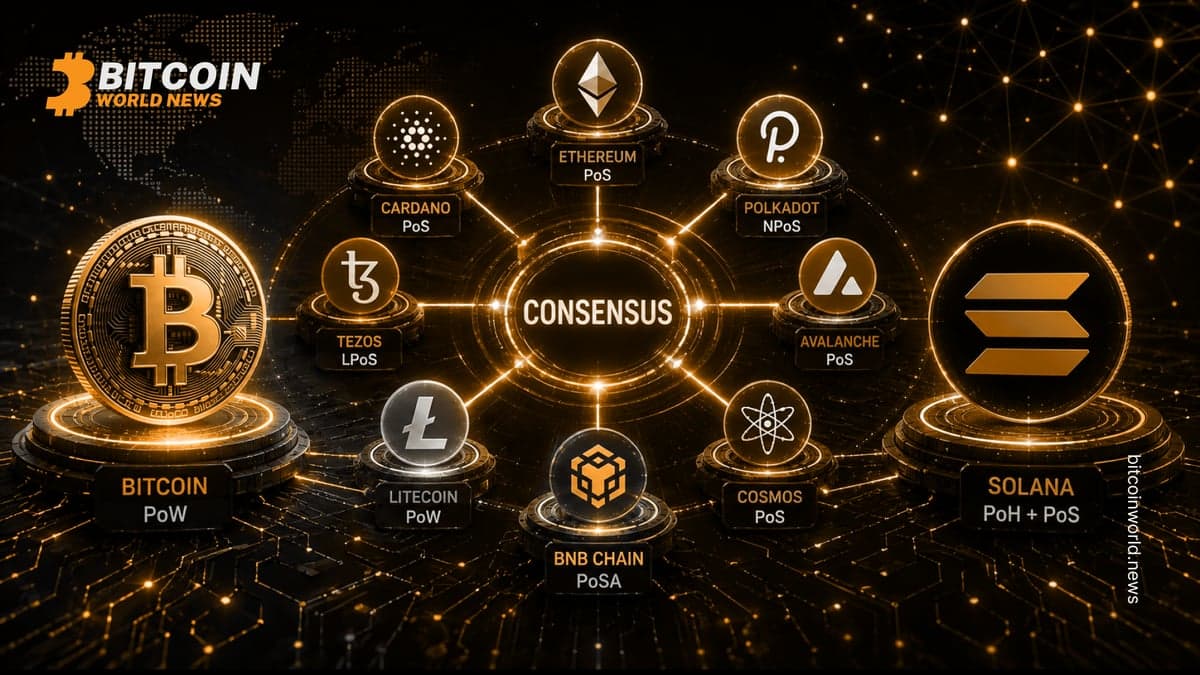
Every blockchain faces a critical challenge: thousands of independent computers must agree on a single transaction history without a central authority. That process, called a consensus algorithm, determines who validates transactions, how competing ledger versions get resolved, and when payments become final across Bitcoin, Ethereum, Solana, and five other major networks.
Bitcoin introduced the model now called Nakamoto Consensus, but Ethereum, BNB Smart Chain, XRP Ledger, Solana, and Tron adopted fundamentally different approaches, according to Bitcoin News. Dogecoin and Zcash remain closer to Bitcoin's original design. Excluding stablecoins, these eight cryptocurrencies represent the largest digital assets by market capitalization.
What Is Nakamoto Consensus and Why Does Bitcoin Use It?
Nakamoto Consensus, Bitcoin's foundational algorithm, solves the problem of establishing a single ledger version across a distributed network without central coordination. The mechanism allows independent computers worldwide to agree on transaction order and finality through computational work, creating a shared accounting book that no single party controls.
A blockchain functions as a shared ledger replicated across computers globally. When competing versions of the transaction history emerge, the consensus mechanism determines which version becomes the authoritative record. Bitcoin's approach relies on proof-of-work mining, where participants expend computational resources to propose new blocks and secure the network against manipulation.
How Do Ethereum and Solana's Approaches Differ from Bitcoin?
Ethereum, BNB Smart Chain, XRP Ledger, Solana, and Tron each implemented distinct consensus mechanisms that prioritize different trade-offs in speed, decentralization, and energy consumption. These networks diverged from Bitcoin's computational-work model to address scalability constraints and transaction throughput limitations.
The fundamental divergence centers on how validators earn the right to add transactions and how the network resolves conflicting ledger versions. While Bitcoin requires miners to solve computational puzzles, alternative networks adopted proof-of-stake models, federated Byzantine agreement protocols, and hybrid architectures that reduce energy requirements while maintaining security guarantees.
What Should Investors Understand About Consensus Trade-offs?
Each consensus mechanism represents engineering choices that affect transaction finality, network security, and validator requirements. Bitcoin's proof-of-work model prioritizes censorship resistance and decentralization but processes roughly 7 transactions per second. Ethereum transitioned to proof-of-stake to reduce energy consumption while maintaining decentralization. Solana's architecture targets higher throughput through a combination of proof-of-stake and proof-of-history timestamps.
The consensus algorithm directly impacts how quickly transactions settle, the cost of running a validator node, and the network's resilience against coordination attacks. Dogecoin and Zcash maintain protocols similar to Bitcoin's Nakamoto Consensus, while BNB Smart Chain, XRP Ledger, and Tron optimize for transaction speed through more centralized validator sets or alternative cryptographic proofs.
Bitcoin Developer Documentation — Proof of Work
Ethereum Documentation — Proof-of-Stake