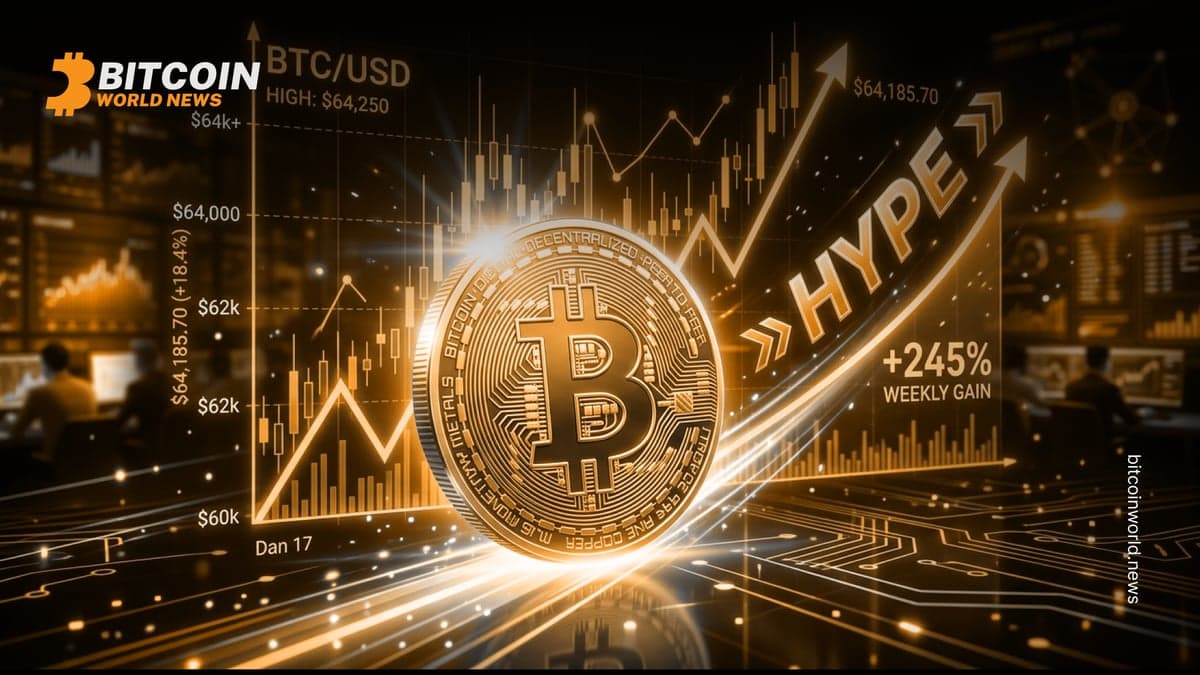
Bitcoin climbed toward $63,500 on Aug. 17 as Goldman Sachs said a September Federal Reserve rate hike is “very unlikely,” adding to expectations that U.S. monetary policy may remain supportive of risk assets.
Bitcoin holds above $63,000 as Fed hike bets fade
Bitcoin was trading around $63,500, up roughly 1% from the start of the day, as traders responded to growing expectations that the Federal Reserve will leave interest rates unchanged at its September meeting.
BTC has remained largely range-bound for more than a month, trading between approximately $62,000 and $66,000 as investors wait for a stronger macro catalyst.
The latest shift in rate expectations could provide some relief for Bitcoin bulls, particularly if weaker economic data continues to reduce pressure on the Fed to tighten monetary policy.
Goldman Sachs sees September rate hike as unlikely
Goldman Sachs Chief Economist Jan Hatzius said a September rate increase now appears “very unlikely,” according to Bloomberg.
Bloomberg report on Goldman Sachs' Fed outlook
The investment bank's assessment follows a series of softer economic indicators, including retail sales, employment data and signs of moderating inflation.
Hatzius said Goldman still believes markets are pricing in a Federal Reserve policy path that is too hawkish.
“We still think market pricing for the funds rate is too hawkish.”
Goldman expects inflation conditions to improve rather than deteriorate significantly as the year progresses, potentially giving policymakers less reason to raise borrowing costs.
Fed policy remains a key Bitcoin catalyst
Interest rates are closely watched by Bitcoin traders because monetary policy influences liquidity, borrowing costs and investor appetite for risk.
Higher interest rates generally make cash and fixed-income assets more attractive while increasing the cost of capital, potentially reducing demand for speculative assets such as Bitcoin.
The opposite can occur when markets anticipate lower rates. Easier monetary conditions can encourage investors to move further out on the risk curve, historically benefiting assets such as technology stocks and cryptocurrencies.
Bitcoin's reaction to monetary policy was particularly visible during the aggressive Federal Reserve tightening cycle that began in 2022, when rising rates contributed to a sharp decline across risk assets.
By contrast, expectations for easier policy following the March 2020 COVID-19 market crash helped create an environment in which Bitcoin and other risk assets eventually staged a powerful recovery.
Markets see only a 30.6% chance of a September hike
Rate futures currently indicate that traders are assigning only about a 30.6% probability to a 25-basis-point Federal Reserve rate increase at the September meeting.
That would take the benchmark federal funds target range to 3.75%–4%.
CME FedWatch Tool
The majority of traders instead expect the Fed to maintain its current target range.
The probability of a hike has fallen following recent economic data showing signs of cooling price pressures and weaker consumption.
For Bitcoin, the decline in rate-hike expectations removes one potential source of near-term macro pressure. However, it does not automatically mean BTC will break higher.
Bitcoin remains trapped in a narrow range
Despite the improvement in the macro backdrop, Bitcoin has yet to establish a decisive trend.
BTC has spent more than a month between roughly $62,000 and $66,000, with buyers repeatedly defending the lower end of the range and sellers limiting advances toward the upper boundary.
A sustained break above $66,000 could strengthen the bullish case and potentially attract momentum traders.
Conversely, a move below $62,000 would risk invalidating the current range structure and could expose Bitcoin to another wave of selling.
That makes upcoming economic data and Federal Reserve communication particularly important for traders looking for the next major catalyst.
Softer economic data could support Bitcoin bulls
The recent economic backdrop has increasingly favored the argument for a less restrictive Fed.
Retail sales and employment indicators have shown signs of moderation, while inflation has continued to cool from earlier peaks.
If that trend continues, policymakers may have less incentive to raise rates in September.
For Bitcoin, the combination of lower rate-hike expectations, softer economic data and a potentially less hawkish Fed could create a more favorable environment for risk assets.
However, Bitcoin still needs stronger spot demand and a decisive technical breakout to turn the improving macro backdrop into a sustained rally.
What happens next for Bitcoin
The September Federal Reserve decision remains one of the most important upcoming macro events for BTC.
Until then, traders will closely monitor inflation, employment, consumer spending and other economic indicators that could influence the Fed's policy path.
For now, Goldman Sachs' view adds to the growing consensus that a September rate hike is unlikely.
Bitcoin remains near $63,500 and inside its long-running $62,000–$66,000 range. If rate-hike expectations continue falling, the macro environment could become increasingly supportive for BTC bulls — but a confirmed breakout is still needed.