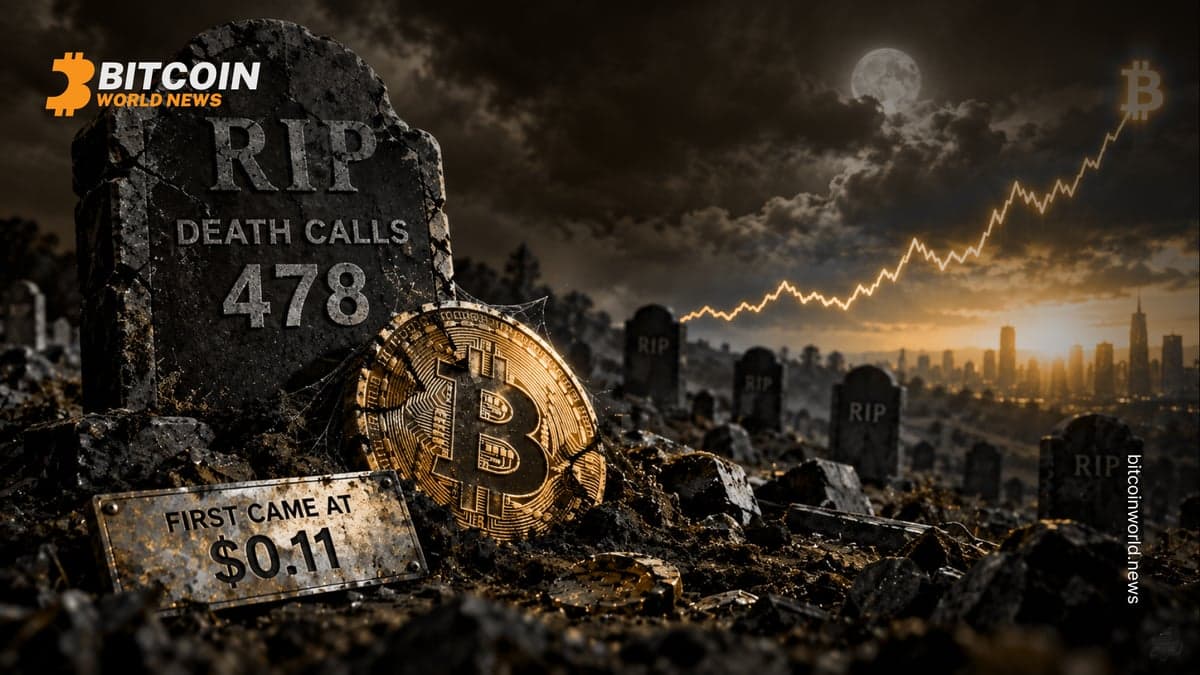
Bitcoin 'Death' Calls Hit 478; First Came at $0.11
Bitcoin (BTC) has been declared “dead” 478 times since 2010, including 24 declarations this month, underscoring persistent skepticism even as the asset has matured. The first obituary arrived in December 2010, when BTC traded at $0.11, highlighting how often peak pessimism has contrasted with subsequent market performance.
Bitcoin (BTC) has been declared “dead” 478 times since 2010, including 24 declarations this month. The first widely logged obituary landed in December 2010, when a single bitcoin traded at $0.11, marking the start of a recurring narrative that has persisted through multiple market cycles.
Public figures have contributed prominently to the tally. Peter Schiff has issued 26 “death” calls, economist Steve Hanke has made 10, and Warren Buffett has delivered eight. The breadth and cadence of these pronouncements illustrate how skepticism has remained a constant feature of bitcoin’s evolution.
Why do 'Bitcoin is dead' calls keep coming back?
They recur because bitcoin’s volatility and cyclical drawdowns create repeated windows for sweeping negative calls, and prominent skeptics amplify those inflection points. With 478 declarations since 2010 and 24 this month alone, the pattern shows how episodic pessimism clusters during turbulent price action and remains part of bitcoin’s public narrative.
Sponsored
The first obituary in December 2010, when BTC traded at $0.11, set an early template: forceful claims of terminal decline emerging during stress or uncertainty. Over time, recognizable voices—26 calls by Peter Schiff, 10 by Steve Hanke, and eight by Warren Buffett—have reinforced the genre’s persistence. The frequency underscores how bitcoin’s disruptive design and unfamiliar valuation frameworks continue to invite categorical dismissals.
Category
Fact
Number / Detail
Total ‘Bitcoin is dead’ declarations
Since 2010
478
Declarations this month
Recent cadence
24
First declaration date
Initial obituary
December 2010
BTC price at first declaration
Market level then
$0.11
Peter Schiff
Number of calls
26
Steve Hanke
Number of calls
10
Warren Buffett
Number of calls
8
What do the numbers show investors?
The data shows that “bitcoin is dead” has become a recurring motif rather than a decisive indicator. With 478 declarations spanning back to 2010 and 24 in the most recent month, investors can see how predictions of terminal failure tend to cluster around volatility, while bitcoin’s longer arc continues to draw both adoption and resistance.
Notably, the timing of the first obituary—December 2010 at a price of $0.11—highlights how early dismissals contrasted with subsequent history. The repeated involvement of well-known figures, including 26 calls from Peter Schiff, 10 from Steve Hanke, and eight from Warren Buffett, further illustrates how authoritative-sounding skepticism can compound sentiment at market extremes without resolving the asset’s underlying debates.
The arithmetic of these moments has now been compiled, offering dollar figures on what ignoring each call would have paid. While those specific return calculations vary by date, the aggregate record emphasizes a consistent theme: categorical obituaries have not halted bitcoin’s development or its ability to rebound after periods of stress.
What should investors watch next?
Investors should track the cadence of new “death” calls alongside market conditions, recognizing that narrative extremes often coincide with elevated volatility. The recent count—24 this month—suggests sentiment can pivot rapidly. Monitoring how these declarations cluster and who is making them can help contextualize risk, positioning, and the durability of bitcoin’s longer-term thesis.
In practice, that means separating noise from signal. The 478 declarations since 2010 reflect opinion intensity more than definitive outcomes. As bitcoin continues to evolve, the frequency and provenance of fresh obituaries will remain a sentiment gauge—useful for color, but historically unreliable as a terminal forecast.
Bottom line: obituary headlines remain part of the bitcoin cycle. Their recurrence offers a read on fear and conviction, not a conclusive judgment on BTC’s future.
This article is for informational purposes only and does not constitute financial, investment, or trading advice. Cryptocurrency markets are highly volatile and carry significant risk. Always conduct your own research (DYOR) and consult a qualified financial advisor before making investment decisions. Past performance does not guarantee future results.
Share
The crypto brief, in your inbox
BTC, markets, and the stories that moved crypto — daily, no noise.