At the same time, DOGE has fallen almost 70% over the past year and was trading near $0.07 during Asian morning hours on Thursday.
The increase in derivatives positioning suggests that traders are willing to take on more leverage even while the underlying asset remains under significant pressure.
DOGE Futures Positioning Returns to 2025 Levels
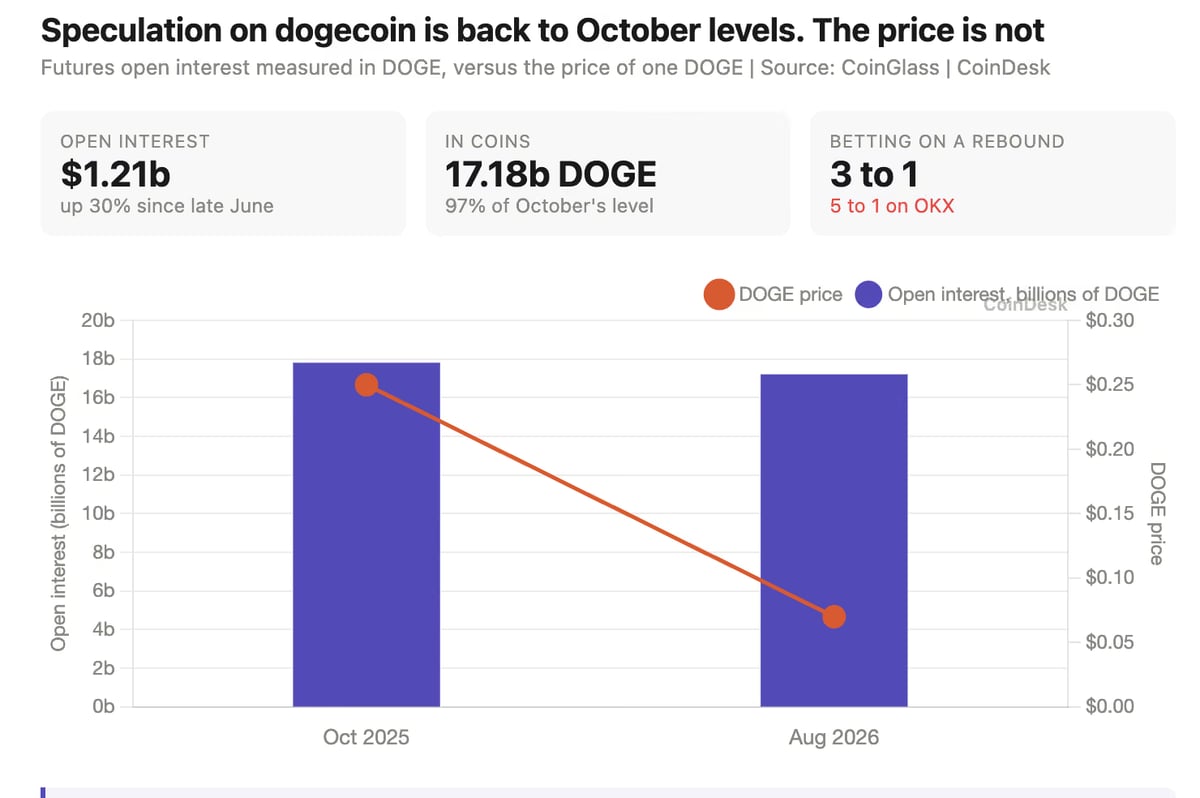
The scale of speculative activity becomes more apparent when open interest is measured in DOGE rather than U.S. dollars.
Current futures open interest stands at approximately 17.18 billion DOGE, compared with around 17.78 billion DOGE in October 2025.
The difference is relatively small.
However, DOGE traded near $0.25 at the time, compared with approximately $0.07 now.
That means the amount of DOGE represented by outstanding futures contracts has nearly returned to previous levels even though the market value of each token has fallen dramatically.
This suggests that speculative interest in DOGE derivatives has recovered despite the much lower spot price.
Rising Open Interest Does Not Automatically Mean DOGE Will Rise
Open interest measures the total value or number of outstanding futures contracts.
When open interest increases, it generally indicates that additional positions are being opened or existing positions are being maintained at higher levels.
However, rising open interest alone does not indicate whether traders are predominantly bullish or bearish.
Every futures contract has both a buyer and a seller.
The more important question is therefore how traders are positioned relative to the current price.
In DOGE's case, exchange-level account data cited in the original analysis points toward a strong preference for long positions.
DOGE Long Positions Outnumber Shorts
On Binance, more than three accounts held long DOGE positions for every account holding a short position, according to the figures cited in the source material.
The ratio on OKX was even higher, exceeding five long accounts for every short account.
These ratios should not be interpreted as meaning that three or five times more capital is positioned for a DOGE rally.
They measure account positioning rather than the exact amount of capital behind each position.
Still, the data suggests that a significant number of traders are positioning for a rebound while DOGE continues to trade near its recent lows.
That creates an important risk for leveraged traders.
Why Crowded DOGE Longs Could Become a Problem
Leverage can amplify both gains and losses.
A trader who opens a leveraged DOGE position needs to maintain enough collateral to support the trade.
If the market moves sharply against that position and the trader's collateral falls below the required level, the exchange can automatically liquidate the position.
For traders holding long DOGE positions, a further decline can therefore trigger forced selling.
If many leveraged traders are positioned in the same direction, liquidations can occur around similar price levels.
That can create additional selling pressure and accelerate a market decline.
This is commonly referred to as a long squeeze.
DOGE Faces a Different Market From October 2025
The comparison with October 2025 is notable because futures positioning has recovered even though DOGE's price has not.
In October, DOGE was trading near $0.25.
Today, the token is around $0.07.
That means traders have rebuilt a similar amount of speculative exposure at a significantly lower price.
The development could indicate that traders are increasingly willing to speculate on a DOGE rebound after the token's substantial decline.
However, it also means that the market could become vulnerable if that expected recovery fails to materialize.
Dogecoin Price Remains Under Pressure
DOGE was trading around $0.07, down roughly 3% over the previous 24 hours in the market snapshot referenced by the source material.
The decline made Dogecoin one of the weaker major cryptocurrencies during the period, even as parts of the broader crypto market moved higher.
For bulls, a sustained recovery would likely require DOGE to regain important technical levels while maintaining healthy spot-market demand.
Simply increasing futures exposure may not be enough to reverse the broader trend.
Futures Data Shows Rising Risk, Not a Guaranteed Rebound
The current derivatives data presents a mixed picture.
On one side, traders are showing renewed interest in DOGE futures, with open interest approaching levels seen when the cryptocurrency was trading at substantially higher prices.
On the other, DOGE remains close to multi-month lows and has lost roughly 70% of its value over the past year.
The combination creates a potentially fragile market structure.
If DOGE rallies, heavily positioned longs could benefit from the move and potentially attract additional momentum traders.
If DOGE falls instead, crowded long positions could become a source of forced selling.
What to Watch Next for DOGE
The key indicators for Dogecoin traders will be price action, futures open interest, funding rates and liquidation activity.
A rise in DOGE accompanied by increasing spot volume could suggest that demand is returning to the underlying market.
By contrast, rising open interest while DOGE continues falling could indicate that leverage is building without sufficient spot demand to support the price.
That would increase the risk of liquidations if the decline accelerates.
For traders monitoring derivatives, CoinGlass provides DOGE futures open-interest data and other market metrics.
Dogecoin's Speculative Market Is Heating Up Again
Dogecoin's latest futures data shows that speculative positioning has returned close to levels last seen in October 2025.
The notable difference is the price.
DOGE traded near $0.25 during that earlier period but is now hovering around $0.07.
With more than three long accounts for every short account on Binance and an even higher ratio on OKX, traders appear increasingly positioned for a recovery.
That bullish positioning could help fuel a rebound if DOGE turns higher.
But if the token continues to fall, the same leverage could work in the opposite direction, triggering liquidations and adding to selling pressure.
For DOGE, the next major move may therefore depend less on how much traders are betting and more on whether the underlying spot market can finally support those increasingly crowded bullish positions.