

Trump Says Big Tech Must Cover Data Center Power Costs as US Electricity Demand Surges
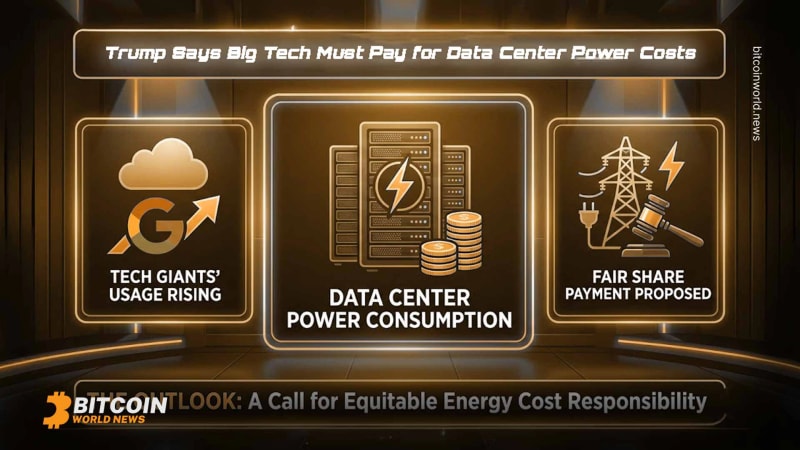
US President Donald Trump has vowed to force major technology companies to absorb the electricity costs of their rapidly expanding data centers, warning that American households should not shoulder higher utility bills as power demand surges.
“I never want Americans to pay higher electricity bills because of data centers,” Trump said Tuesday in a post on his Truth Social platform.
Trump blamed Democrats for rising household electricity prices and said his administration is working directly with large US tech firms to secure commitments that prevent consumers from subsidizing corporate power usage. He said a formal announcement is expected in the coming weeks.
Electricity Prices Have Risen Sharply Since 2020
According to data from the Federal Reserve Bank of St. Louis, the average electricity price per kilowatt-hour in major US cities has climbed roughly 40% over the past five years, reflecting rising demand, infrastructure constraints, and higher generation costs.
Trump said his administration’s priority is ensuring that everyday Americans do not “pick up the tab” for electricity consumption driven by AI data centers and cloud computing expansion.
Microsoft to Make Changes as Talks Advance
Trump singled out Microsoft as the first major company to commit to changes.
“Microsoft, who we’ve been working with, will begin making major changes this week to ensure Americans don’t pay higher utility bills because of their power consumption,” Trump said.
He added that while the US is “number one in AI” and data centers are critical to national security and economic leadership, large technology companies must “pay their own way.”
US Data Center Power Demand Is Accelerating
Electricity usage from data centers has grown rapidly alongside AI adoption.
According to Visual Capitalist, US data centers consumed approximately 224 terawatt-hours (TWh) of electricity in 2025—about 5.2% of total US power demand, marking a 21% increase year over year.
Projections from McKinsey & Company suggest that by 2030, US data center electricity consumption could exceed 600 TWh, representing nearly 12% of national power usage.
Cooling and Servers Drive Energy Consumption
Energy use within data centers is heavily concentrated in cooling systems and computing hardware:
- Cooling systems: 30%–40% of total facility energy use
- Servers and IT equipment: 40%–60% of total power consumption
The International Energy Agency (IEA) estimates that electricity demand from AI-focused data centers is growing at roughly 30% annually, far outpacing the 9% growth rate of conventional server workloads.
Bitcoin Mining Enters the Power Debate
Bitcoin mining—another energy-intensive industry—has also drawn scrutiny over electricity usage. However, recent analysis challenges the assumption that it drives higher consumer power costs.
Last week, ESG analyst Daniel Batten compared US electricity price increases from 2021 to 2024 with Texas, a state that hosts a high concentration of Bitcoin mining operations. He found that utility price increases in Texas closely mirrored the national average.
“Neither the data nor peer-reviewed studies support the claim that Bitcoin mining increases consumer power bills,” Batten said.
Environmental and Grid Benefits Cited by Mining Advocates
Supporters of Bitcoin mining argue that the industry provides several systemic benefits, including:
- Acting as a flexible buyer for renewable energy
- Reducing bottlenecks in grid-connected renewable projects
- Funding green energy research and development
- Capturing and eliminating methane emissions from landfills and oil fields
These arguments have increasingly entered policy discussions as governments grapple with rising electricity demand from digital infrastructure.
What Comes Next
As AI, cloud computing, and crypto infrastructure continue to expand, pressure is mounting on policymakers to balance innovation with grid stability and consumer protection.
Trump’s push to make tech firms directly fund their electricity usage could signal a broader shift in how governments regulate data center expansion—especially as power demand approaches levels once reserved for heavy industry.
See all our insights: Bitcoin World News
Disclaimer: The content on this website is for informational purposes only and does not constitute financial or investment advice. We do not endorse any project or product. Readers should conduct their own research and assume full responsibility for their decisions. We are not liable for any loss or damage arising from reliance on the information provided. Crypto investments carry risks.