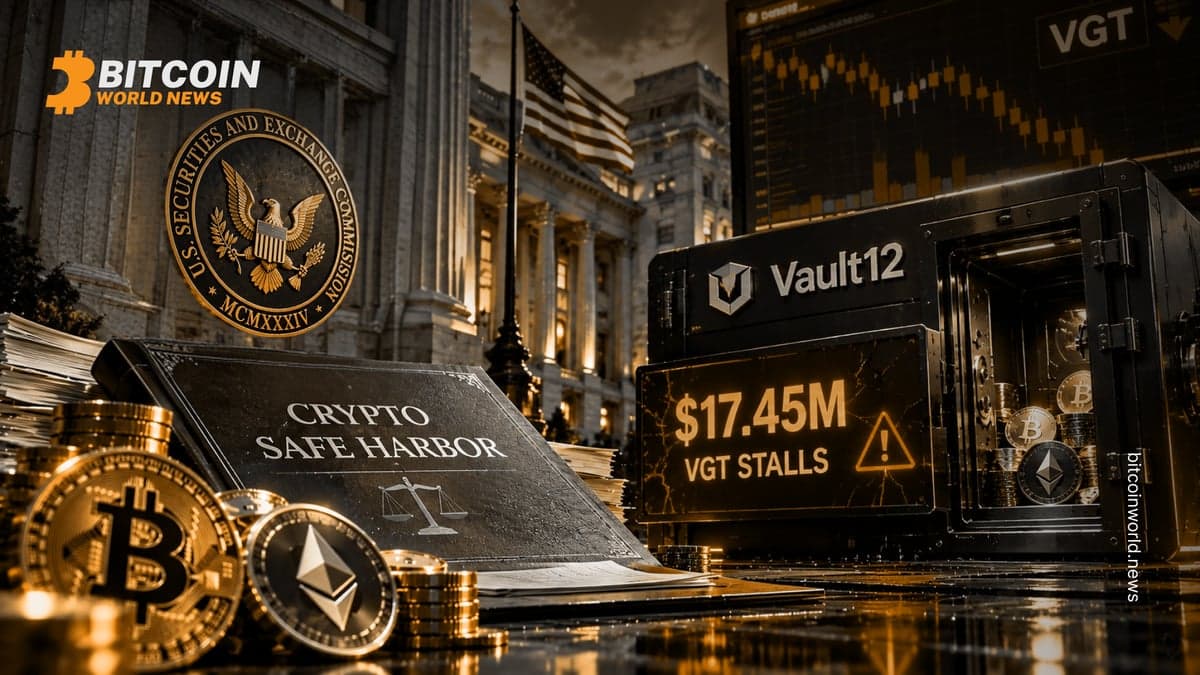
SEC crypto safe harbor is facing an early test as Vault12 warns centralized exchanges may refuse to list legacy tokens without explicit immunity. The crypto wallet backup firm raised $17.45 million from 38 investors in 2018 for its Vault Guardian Token (VGT), which has never traded on a major exchange, highlighting listing risk under the proposed framework.
The safe harbor sits within the Securities and Exchange Commission’s Regulation Crypto Assets proposal, issued in August, which sets conditions under which a token would no longer be bound by its original investment contract. Vault12, backed by Winklevoss Capital and Naval Ravikant, argues that ambiguity could keep VGT and similar assets off centralized platforms amid fear of later regulatory challenges.
Why are exchanges steering clear without explicit SEC immunity?
Exchanges face uncertainty that a token, even after meeting safe harbor milestones, could later draw a regulatory challenge. Without explicit immunity, listing a legacy cryptocurrency can look like a future enforcement risk, potentially exposing venues if the issuer’s compliance later proves insufficient under the SEC’s proposed conditions.
That risk calculus is evident in VGT’s path: despite funding via agreements for future tokens in 2018, VGT has not appeared on centralized markets. The absence of a bright-line exemption can incentivize exchanges to default to caution, avoiding assets that originated in investment contracts until protections are clearer or codified.
Event | Entity | Timing/Amount |
|---|
Token raise via agreements for future tokens | Vault12 / VGT | $17.45 million from 38 investors (2018) |
Proposal outlining safe harbor conditions | SEC Regulation Crypto Assets | Issued in August |
Exchange listing status | Vault Guardian Token (VGT) | Never traded on a centralized exchange |
What does the SEC’s proposed safe harbor actually change?
The proposal defines conditions under which a token may no longer be tied to its original investment contract, aiming to provide a pathway from issuance to broader circulation. In practice, uncertainty about post-compliance liability remains, leaving exchanges hesitant to list tokens without explicit, durable immunity from later enforcement.
For issuers like Vault12, the framework’s intent is to transition a crypto asset into a non-security status once requirements are satisfied. But if exchanges perceive residual risk that status could be second-guessed, they may continue to sidestep listings, undercutting the framework’s utility for legacy tokens that have yet to attain centralized market access.
What should token issuers and venues watch next?
Issuers and exchanges should monitor whether the SEC refines the proposal with clearer, enforceable protections that reduce the threat of retroactive challenge. Explicit immunity or unequivocal criteria would directly address listing paralysis for legacy tokens and could determine whether assets like VGT gain centralized exchange pathways under the regime.
Backers and teams may also reassess their distribution strategies until regulatory certainty improves. Without sharper guardrails, the practical outcome for legacy tokens may remain unchanged: continued absence from centralized venues despite early fundraising, institutional backing, and an aspirational safe harbor intended to facilitate secondary market access.
Clarity on the contours of the safe harbor will shape how quickly exchanges adapt their listing pipelines. Until then, conservative risk management by platforms is likely to persist, particularly for tokens launched via investment contracts that have yet to debut on major marketplaces.