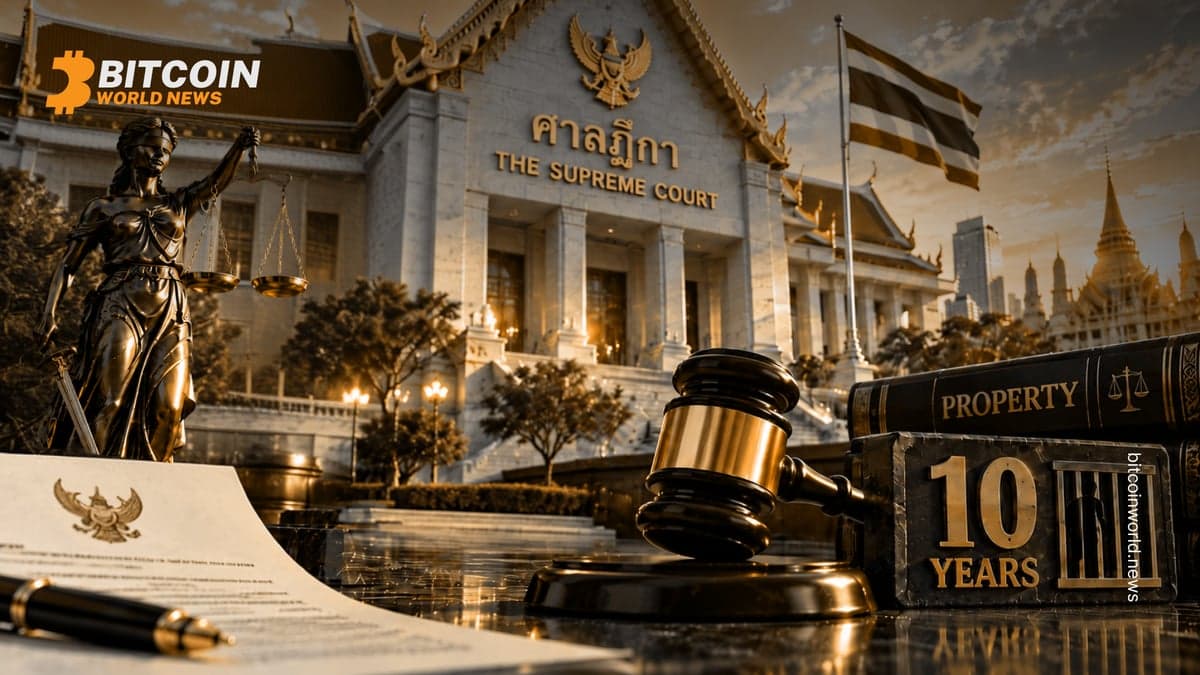
Thailand’s Supreme Court has ruled that bitcoin is property, concluding that the cryptocurrency has a market price, can be cashed out, and is capable of being held by the public. In the same decision, the court upheld a 10-year prison sentence for a man convicted of assisting robbers in a bitcoin-related theft case.
The judgment resolves a key question over bitcoin’s legal character in Thailand’s courts and sets an enforceable precedent for how digital assets may be handled in criminal matters, including seizure, restitution, and victim compensation.
Why did the Thai Supreme Court deem bitcoin to be property?
The court determined bitcoin qualifies as property because it has a market price, can be converted to cash, and is held by members of the public. These characteristics were sufficient for the judges to classify BTC as property under Thai law, placing it within existing legal frameworks for ownership and transfer.
By emphasizing bitcoin’s tradability and convertibility, the ruling aligns the asset’s economic reality with its legal treatment. Recognition of market price and cash-out capability anchors bitcoin within property regimes typically applied to valuable, transferable assets. The finding addresses long-standing uncertainty over whether intangible, cryptographic assets sit outside traditional property definitions in Thai jurisprudence.
What does the ruling mean for criminal cases and restitution?
The decision signals that courts in Thailand can treat bitcoin like other property in criminal proceedings, including recognizing ownership, calculating loss based on market value, and ordering remedies. That approach supports seizure and recovery processes in theft cases and clarifies liability for accomplices and facilitators.
The Supreme Court’s affirmation of a 10-year prison sentence for a convicted accomplice underscores the legal system’s readiness to apply standard property-crime doctrines to bitcoin. By tying culpability and penalties to property-related offenses, the ruling provides a clearer path for prosecutors, victims, and investigators when digital assets are targeted in robberies or fraud schemes.
What should market participants in Thailand watch next?
Businesses and individuals should expect bitcoin to be handled as property in future disputes, including asset tracing, seizure, and valuation during litigation. The ruling reduces ambiguity for compliance teams, custodians, and exchanges operating in Thailand by aligning bitcoin with existing property law concepts that guide enforcement and recovery.
While the decision centers on criminal liability and remedies, its reasoning—market pricing, cash convertibility, and public holdability—offers a framework that may influence civil cases, insolvency treatment, and contractual disputes involving bitcoin. Market participants should review custody controls and documentation practices to ensure they can evidence ownership and valuation in potential proceedings.