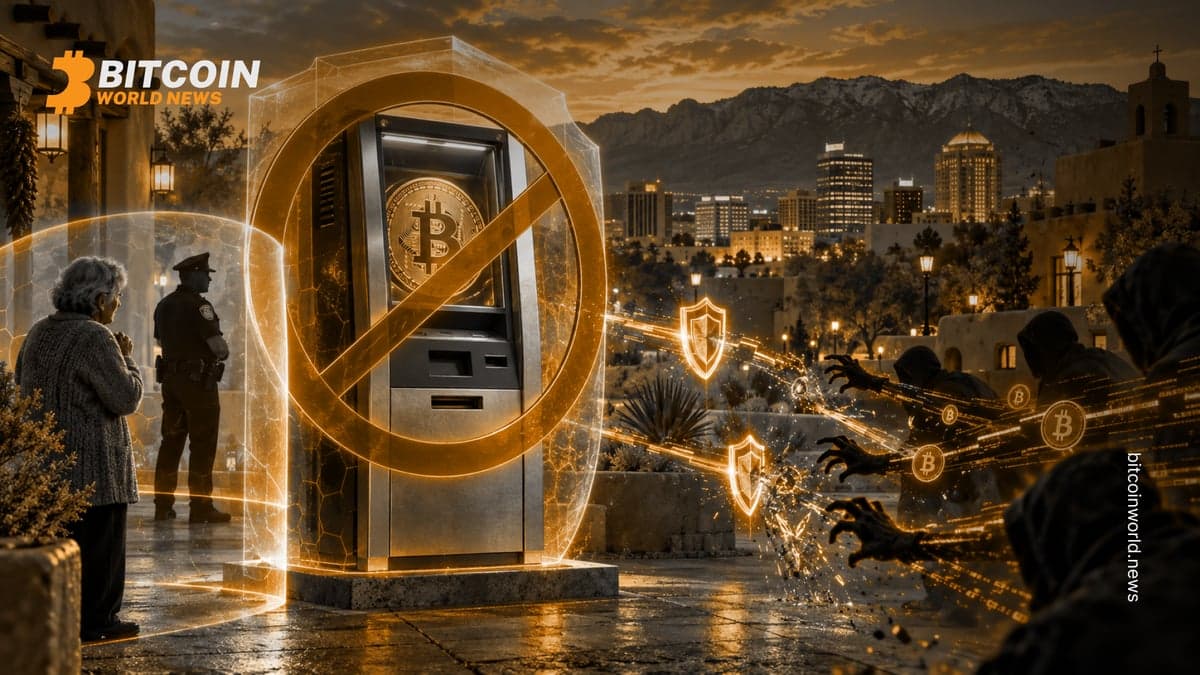
The City of Albuquerque has approved a broad ban on cryptocurrency ATMs and cashier-facilitated virtual currency transactions, making it one of the latest U.S. jurisdictions to take action against crypto kiosks over fraud concerns.
The Albuquerque City Council approved O-26-49, formally known as the “Virtual Currency Ordinance.” The city announced the measure on September 10, 2026, while the council’s legislative record shows the ordinance received final action on September 9. The legislation was sponsored by Councilors Stephanie W. Telles and Tammy Fiebelkorn.
According to the city, the ordinance is designed to protect older adults and other vulnerable residents who may be targeted through impersonation scams, coercive payment schemes and other forms of financial fraud involving physical cryptocurrency kiosks.
What Albuquerque’s Crypto ATM Ban Covers
The ordinance goes beyond simply prohibiting the operation of crypto ATMs. It bars the installation, hosting, operation, facilitation, servicing, leasing, advertising and availability of virtual currency ATMs within Albuquerque.
It also covers transactions where a cashier, clerk, employee, retailer or intermediary collects payment in person on behalf of a virtual currency provider. This means businesses that host a kiosk or facilitate covered transactions can also face enforcement under the ordinance.
The city’s official legislation record for O-26-49 states that the prohibition applies regardless of whether the transaction involves Bitcoin, Ethereum, stablecoins or another digital asset. It also applies whether the kiosk is operated by a third party and whether a transaction is custodial or non-custodial.
Existing Crypto ATMs Must Be Removed
The ordinance requires existing virtual currency ATMs in Albuquerque to stop operating immediately once the ordinance becomes effective. They must then be physically removed within 45 days of the effective date.
The legislation also establishes penalties for violations. Fines can accumulate, with each day of continued violation treated as a separate offense. The city can also pursue business-license revocation and court-ordered enforcement, while each prohibited ATM can constitute a separate violation.
The city's announcement says property owners, landlords and retailers that allow prohibited activity can also be held accountable. This expands the measure beyond kiosk operators and places responsibility on businesses and property hosts that permit the machines to operate.
Why Albuquerque Is Targeting Crypto Kiosks
City officials say the decision is driven primarily by the growing use of cryptocurrency kiosks in fraud schemes.
Councilor Stephanie W. Telles, a co-sponsor of the ordinance, argued that the high fees associated with these kiosks make them unattractive for ordinary users while leaving them useful to criminals. She said 90% of crypto ATM transactions in Albuquerque are tied to fraud, describing the machines as a source of serious consumer harm.
Councilor Tammy Fiebelkorn similarly described the ban as a proactive response to scams affecting local residents. She said Albuquerque should not wait for federal regulators to address the issue and argued that removing the physical infrastructure could reduce opportunities for fraudulent transactions.
Federal data provides broader context for the city's concerns. The FBI’s Internet Crime Complaint Center reported 13,460 complaints involving cryptocurrency kiosks in 2025, with adjusted losses of $388,981,267. More than half of the complaints involved people over 50, while losses involving people over 50 exceeded $302 million.
The FBI’s cryptocurrency kiosk complaint data also explains that scammers commonly instruct victims to withdraw cash, find a cryptocurrency kiosk and use the machine to send funds. The FBI warns that legitimate government officials and law enforcement agencies will not demand payment through cryptocurrency kiosks.
The Ban Does Not Prohibit Cryptocurrency
Despite the breadth of the kiosk restrictions, Albuquerque’s ordinance does not ban cryptocurrency itself.
Section 13-22-5 specifically preserves lawful cryptocurrency ownership, possession, mining, software development, blockchain activities and private transfers that do not involve a prohibited ATM or cashier-facilitated transaction.
That distinction means residents can still hold digital assets and use internet-based platforms and personal wallets. The city's action is focused on physical cryptocurrency kiosks and in-person retail facilitation rather than cryptocurrency as an asset class.
This distinction is important because the ordinance targets a particular method of converting or transmitting funds rather than attempting to prohibit blockchain networks or digital assets more broadly.
Crypto ATM Restrictions Are Expanding Across the U.S.
Albuquerque's decision comes amid a broader U.S. crackdown on cryptocurrency kiosks.
Tennessee's statewide prohibition took effect on July 1, 2026. The Tennessee Attorney General's Office said the law makes knowingly installing, permitting, placing or operating a virtual currency kiosk a Class A misdemeanor. A federal court previously rejected an emergency request from industry participants seeking to block the law from taking effect.
The Tennessee Attorney General’s announcement said the state's legislation followed testimony about crypto ATMs being used in scams that caused significant losses to victims.
Federal regulators have also documented the vulnerability of older adults to crypto ATM scams. The Federal Trade Commission reported that consumers lost more than $110 million to Bitcoin ATM-related scams in 2023, while losses topped $65 million during the first six months of 2024. People aged 60 and over were more than three times as likely as younger adults to report a Bitcoin ATM-related loss during that 2024 period.
Crypto ATM Network Has Also Contracted
The regulatory pressure comes as the broader cryptocurrency ATM network has already experienced a significant decline.
Coin ATM Radar data cited in July showed the global number of tracked crypto ATMs falling from 38,708 on May 1, 2026, to 27,945 on July 8, a reduction of 10,763 machines. The decline was heavily concentrated in the United States.
The figures should be described as a global decline rather than a U.S.-only drop. U.S. installations were separately reported at about 30,247 on March 29 and 20,005 by July 8. Bitcoin Depot's Chapter 11 bankruptcy and state-level restrictions were among the factors associated with the contraction.
For Albuquerque, the new ordinance adds another local restriction to that broader shift. Rather than banning cryptocurrency itself, the city has chosen to remove a physical payment channel that officials believe has become closely associated with fraud against vulnerable consumers.
The policy will now move from legislation to enforcement, with operators and businesses expected to comply with the ban and the 45-day removal requirement following the ordinance's effective date.