Global M2 Reaches Record Levels as Bitcoin Rallies
Bitcoin's latest rally has brought global liquidity back into focus after the world's money supply reached record levels.
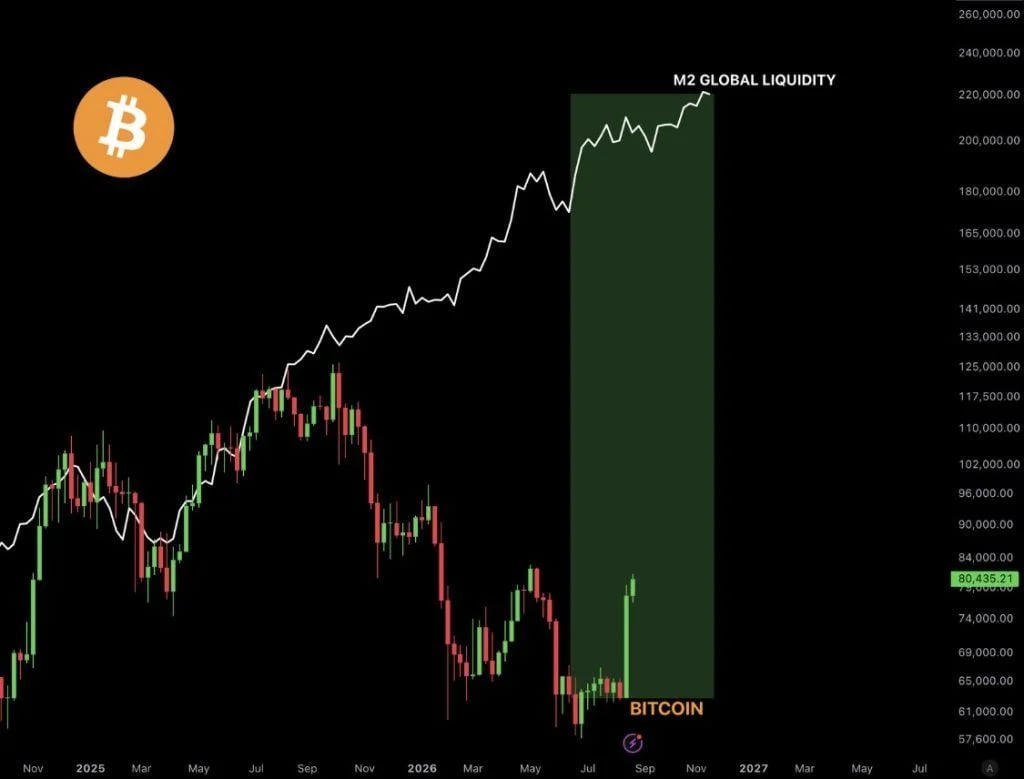
BTC has climbed more than 20% over the past seven days, recently moving above $81,000 before settling back around the upper-$70,000 range. At the same time, estimates of global M2 have reached unprecedented levels, creating a fresh debate over whether Bitcoin is beginning to catch up with the liquidity already sitting inside the global financial system.
The relationship between money supply and Bitcoin is not a direct price formula. However, expanding liquidity can influence how much capital investors are willing to allocate toward riskier and alternative assets.
For official U.S. money-supply data, the Federal Reserve's H.6 Money Stock Measures provides the latest M2 figures. The Federal Reserve's data shows U.S. M2 at roughly $23.2 trillion in the latest available monthly reading.
Global M2 Pushes Into Record Territory
Global M2 combines broad money-supply measures across major economies, including the United States, China, the euro area and Japan.
Various private-sector estimates place global M2 at roughly $103 trillion, although methodologies differ between providers. Some estimates are significantly higher depending on which countries, monetary aggregates and liquidity measures are included.
The important point is not necessarily the precise global figure but the direction of liquidity.
When the amount of money available across economies expands, investors have more capital that can eventually move between deposits, bonds, equities, commodities and alternative assets.
That makes global liquidity an important macroeconomic variable for Bitcoin traders.
The Federal Reserve's official M2 data shows how U.S. broad money has continued to expand, with the June 2026 reading at approximately $23.16 trillion.
Bitcoin's Rally Reignites the Liquidity Trade
Bitcoin's recent price surge has renewed the argument that BTC could be entering a catch-up phase relative to global liquidity.
Bitcoin moved from around $63,000 at the beginning of August to above $81,000 at its recent weekly high, representing a substantial increase in a relatively short period.
The move has coincided with several macro developments, including changes in Treasury-market conditions and expectations surrounding U.S. liquidity.
Bitcoin remains well below its previous record above $126,000, however, meaning the latest rally has not yet erased the large gap between current prices and the previous cycle high.
That gap is one reason some investors believe Bitcoin could have additional room to move if liquidity conditions remain supportive.
Why M2 Matters for Bitcoin
Bitcoin's monetary structure is fundamentally different from that of fiat currencies.
The Bitcoin network is designed around a maximum supply of 21 million BTC, while national money supplies can expand or contract based on monetary and banking conditions.
This scarcity is one reason Bitcoin is often compared with assets such as gold when investors become concerned about currency debasement or expanding money supply.
The Bitcoin protocol establishes the network's supply mechanics and issuance schedule.
However, a rising M2 figure does not automatically mean Bitcoin must rise.
New liquidity can remain inside bank deposits, money-market funds or government securities for extended periods. Investors may also prefer assets offering attractive yields rather than immediately moving into cryptocurrencies.
The critical question is therefore not simply whether M2 is rising, but where the additional liquidity eventually flows.
Bitcoin and M2 Have Historically Moved Together at Times
Bitcoin's previous major bull markets have often occurred during periods of significant global liquidity expansion.
The 2017-18 cycle coincided with a broader increase in global liquidity, while the 2020-21 Bitcoin bull market was accompanied by extraordinary monetary and fiscal stimulus following the COVID-19 shock.
The reverse can also occur.
When central banks tighten financial conditions, interest rates rise and liquidity becomes less abundant, speculative assets can face significant pressure.
This relationship is one reason macro investors continue monitoring monetary aggregates when assessing the broader Bitcoin cycle.
It is important, however, not to interpret historical correlation as a guaranteed trading signal.
The U.S. Dollar Could Decide Bitcoin's Next Move
Global liquidity is only one part of the equation.
The strength of the U.S. dollar can also influence Bitcoin's performance because a stronger dollar can tighten financial conditions and make dollar-denominated assets more attractive.
A weaker dollar can have the opposite effect by encouraging investors to look for alternative stores of value and higher-return assets.
Gold and Bitcoin can both benefit when investors become concerned about currency purchasing power, inflation or fiscal sustainability.
That makes the interaction between M2, the dollar, Treasury yields and Bitcoin more important than any single liquidity metric.
Treasury Yields Remain a Key Variable
Treasury yields are another important piece of the liquidity puzzle.
When yields rise sharply, investors may have less incentive to move capital into volatile assets because relatively safe government securities offer more attractive returns.
When yields decline, the opportunity cost of holding riskier assets can fall.
This is why Bitcoin traders often monitor Treasury yields alongside liquidity indicators rather than treating M2 as a standalone predictor.
The latest Bitcoin rally has therefore developed against a broader macro backdrop involving Treasury markets, dollar strength and expectations for future monetary conditions.
Is Bitcoin Finally Catching Up With Global Liquidity?
The recent price action has encouraged some analysts to argue that Bitcoin may finally be catching up with the expansion in global money supply.
That thesis is straightforward: if global liquidity continues expanding and more capital begins moving toward scarce or higher-risk assets, Bitcoin could potentially benefit.
The argument becomes particularly interesting because BTC has already rallied sharply but remains below its previous all-time high.
If liquidity conditions continue improving, Bitcoin could have room to absorb additional capital without necessarily requiring global M2 to increase at the same pace as it has in previous periods.
But the opposite scenario is also possible.
If inflation remains persistent, Treasury yields rise or the dollar strengthens significantly, liquidity could remain trapped in traditional assets rather than flowing into Bitcoin.
What Bitcoin Traders Should Watch Next
The next stage of the Bitcoin rally will depend on whether liquidity continues translating into actual demand for risk assets.
Traders should monitor:
Global M2 and U.S. M2 growth
U.S. dollar strength
Treasury yields
Spot Bitcoin ETF flows
Federal Reserve policy expectations
Bitcoin's ability to hold above $78,000-$80,000
BTC's potential resistance around $82,000 and higher
The Federal Reserve remains one of the most important sources for tracking U.S. monetary-policy and money-supply developments, while the FRED M2 series provides a continuously updated reference for U.S. broad money.
Bitcoin's Liquidity Catch-Up Thesis Is Not Guaranteed
Record global M2 does not automatically translate into a higher Bitcoin price.
The more important question is whether expanding liquidity actually reaches assets such as Bitcoin, gold and equities rather than remaining parked in cash, deposits or fixed-income instruments.
For now, Bitcoin's sharp weekly rally has reopened the liquidity narrative. If global money supply continues expanding while the dollar and yields remain relatively supportive, BTC could potentially continue absorbing capital from the broader financial system.
But if financial conditions tighten again, the same liquidity trade could reverse.
The key takeaway is that Bitcoin may be starting to catch up with the enormous pool of global liquidity, but M2 alone is not a price target. The next major BTC move will depend on whether record money supply turns into actual demand for scarce and risk-sensitive assets.