

IBIT Ranks 6th in 2025 ETF Inflows Despite Losses, Signaling Strong Long-Term Bitcoin Conviction
IBIT Defies Performance Trends With Strong 2025 Inflows
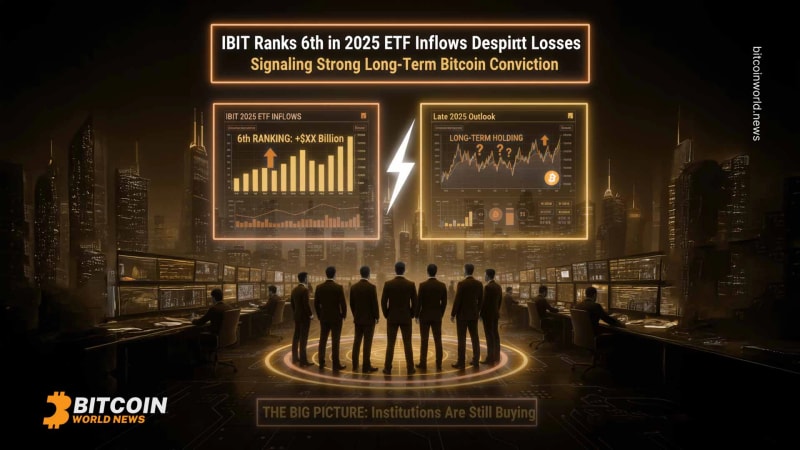
BlackRock’s spot Bitcoin ETF, iShares Bitcoin Trust (IBIT), has emerged as one of the most notable ETF stories of 2025. Despite posting a negative return for the year, IBIT ranked sixth among all ETFs in year-to-date inflows, highlighting sustained investor demand even during a challenging price environment.
According to data shared by Bloomberg ETF analyst Eric Balchunas, IBIT has attracted approximately $25 billion in net inflows so far this year—making it the only ETF in the top rankings delivering negative annual performance.
Bitcoin ETF Attracts More Capital Than High-Performing Peers
What makes IBIT’s performance particularly striking is the comparison with traditional assets. Several ETFs ranked above IBIT on the inflow leaderboard posted double-digit gains, while SPDR Gold Shares (GLD)—up more than 60% in 2025—still drew less capital than IBIT.
Balchunas described the trend as a meaningful signal of investor behavior rather than a contradiction.
“If you can do $25 billion in a bad year, imagine the flow potential in a good year,” Balchunas wrote, calling the trend a “HODL clinic” led by older, long-term investors.
Source
The data suggests that many investors are prioritizing long-term exposure over short-term performance, reinforcing Bitcoin’s evolving role as a strategic asset.
Why Strong ETF Demand Hasn’t Lifted Bitcoin’s Price
Despite steady institutional inflows, Bitcoin’s price has struggled to reflect the buying pressure. This disconnect has raised questions among market participants about why ETF accumulation hasn’t translated into stronger upside momentum.
Balchunas offered several explanations, noting that Bitcoin may now be behaving more like a mature asset class. Early adopters and long-term holders may be:
- Taking profits into strength
- Deploying income strategies such as selling call options
- Rebalancing portfolios rather than aggressively adding exposure
He also pointed out that Bitcoin gained over 120% last year, making sustained follow-through less likely without fresh catalysts.
Short-Term Outflows Reflect Broader Market Caution
On Friday, U.S. spot Bitcoin ETFs recorded $158 million in net outflows, with Fidelity’s FBTC standing out as the only fund to attract inflows.
Ethereum-based products also faced pressure, with spot Ether ETFs seeing $75.9 million in outflows, marking their seventh consecutive day of net withdrawals.
- Bitcoin (BTC): ~$88,228
- Ethereum (ETH): ~$2,986
The data reflects short-term risk aversion rather than a reversal of long-term allocation trends.
BlackRock Pushes Back on IBIT Outflow Concerns
IBIT experienced heavier selling pressure in November, recording roughly $2.34 billion in net outflows, including two significant withdrawal days mid-month. Despite this, BlackRock executives have dismissed concerns over the fund’s durability.
Speaking at Blockchain Conference 2025 in São Paulo, BlackRock business development director Cristiano Castro emphasized that Bitcoin ETFs have become one of the firm’s largest revenue-generating products.
He noted that ETFs are designed to support:
- Capital rotation
- Cash-flow managemen
- Portfolio rebalancing
As a result, periods of compression and outflows are a normal part of ETF lifecycle dynamics.
Conclusion: IBIT’s Inflows Signal Structural Demand, Not Speculation
IBIT’s ability to rank among the top ETFs by inflows during a down year underscores a deeper shift in investor behavior. Rather than chasing momentum, capital appears to be positioning for long-term exposure to Bitcoin through regulated vehicles.
While short-term price action remains uneven, the data suggests institutional conviction is strengthening, not fading—an important signal as Bitcoin continues to integrate into traditional financial markets.
Disclaimer: The content on this website is for informational purposes only and does not constitute financial or investment advice. We do not endorse any project or product. Readers should conduct their own research and assume full responsibility for their decisions. We are not liable for any loss or damage arising from reliance on the information provided. Crypto investments carry risks.