

February Crypto Losses Hit Lowest Level Since March 2025 as Security Measures Improve
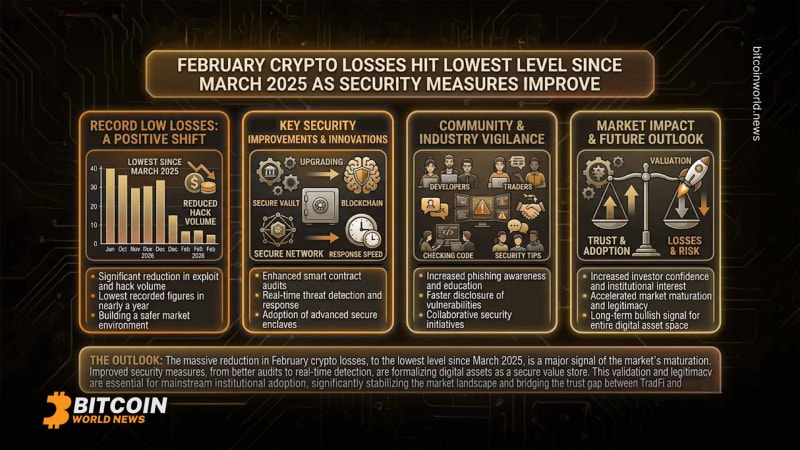
Crypto Hack Losses Fall Sharply in February
Cryptocurrency losses from hacks, scams, and exploits declined significantly in February, reaching their lowest monthly level since March 2025, according to blockchain security firm PeckShield.
The firm reported that total losses across the crypto ecosystem amounted to $26.5 million, marking a 69.2% decrease compared to January’s losses of more than $86 million.
Out of 15 recorded security incidents, only two exploits accounted for the majority of February’s damages, highlighting a notable slowdown in large-scale attacks.
Major Exploits Behind February’s Losses
The largest incident involved decentralized lending protocol YieldBlox, where attackers executed a price manipulation attack targeting a DAO-managed lending pool. The exploit resulted in approximately $10 million in losses on Feb. 21.
The second-largest breach affected decentralized identity protocol IoTeX, which suffered around $8.9 million in damages following a private key compromise on the same day.
Despite these incidents, February avoided the kind of massive breaches that previously inflated industry loss figures.
Absence of Mega Hacks Helped Reduce Damage
According to PeckShield analysts, February’s relatively low losses were partly due to the absence of “mega-hacks,” such as the $1.5 billion exploit targeting Bybit in February 2025, which significantly skewed last year’s statistics.
Market conditions also played a key role. Increased volatility — including Bitcoin briefly falling below $70,000 — shifted industry attention toward liquidity management and institutional risk control rather than exploiting protocol vulnerabilities.
Stronger Security Standards Emerging
Analysts believe the decline may signal structural improvements in crypto security practices.
Dominick John, analyst at Kronos Research, noted that tighter counterparty standards, improved monitoring systems, and stronger institutional risk frameworks are helping reduce vulnerabilities.
Capital allocation is increasingly favoring projects with mature security infrastructure, encouraging protocols to invest heavily in:
- Smart contract audits
- Formal verification processes
- Real-time threat monitoring
- Institutional-grade custody protections
If these trends continue, industry losses could decline further throughout 2026.
AI Is Becoming a Security Game-Changer
Artificial intelligence is also emerging as a powerful defensive layer in blockchain security.
AI-powered tools are now enabling:
- Automated smart contract code reviews
- Anomaly detection systems
- Pre-deployment attack simulations
- Continuous vulnerability scanning
These technologies allow developers to identify weaknesses earlier in the development lifecycle, reducing exploit opportunities before protocols go live.
Phishing Still Remains the Biggest Threat
While protocol exploits declined, phishing attacks continue to pose a major risk.
Wallet drainer-related losses have fallen sharply in 2025 — dropping from $494 million to $83.85 million — yet attackers are increasingly targeting users instead of smart contracts.
Security experts warn that social engineering attacks remain highly effective because they exploit human behavior rather than technical flaws.
Industry recommendations include:
- Using multi-signature wallets
- Storing assets in cold storage
- Protecting private keys rigorously
- Verifying links and transaction approvals
Crypto Security Is Entering a Maturity Phase
The February data suggests the crypto industry may be entering a more mature security era, driven by institutional participation, stricter funding standards, and advanced monitoring technologies.
However, experts caution that the rapidly evolving blockchain ecosystem ensures security will remain a continuous arms race between innovators and attackers.
See all our insights: Bitcoin World News
Disclaimer: The content on this website is for informational purposes only and does not constitute financial or investment advice. We do not endorse any project or product. Readers should conduct their own research and assume full responsibility for their decisions. We are not liable for any loss or damage arising from reliance on the information provided. Crypto investments carry risks.