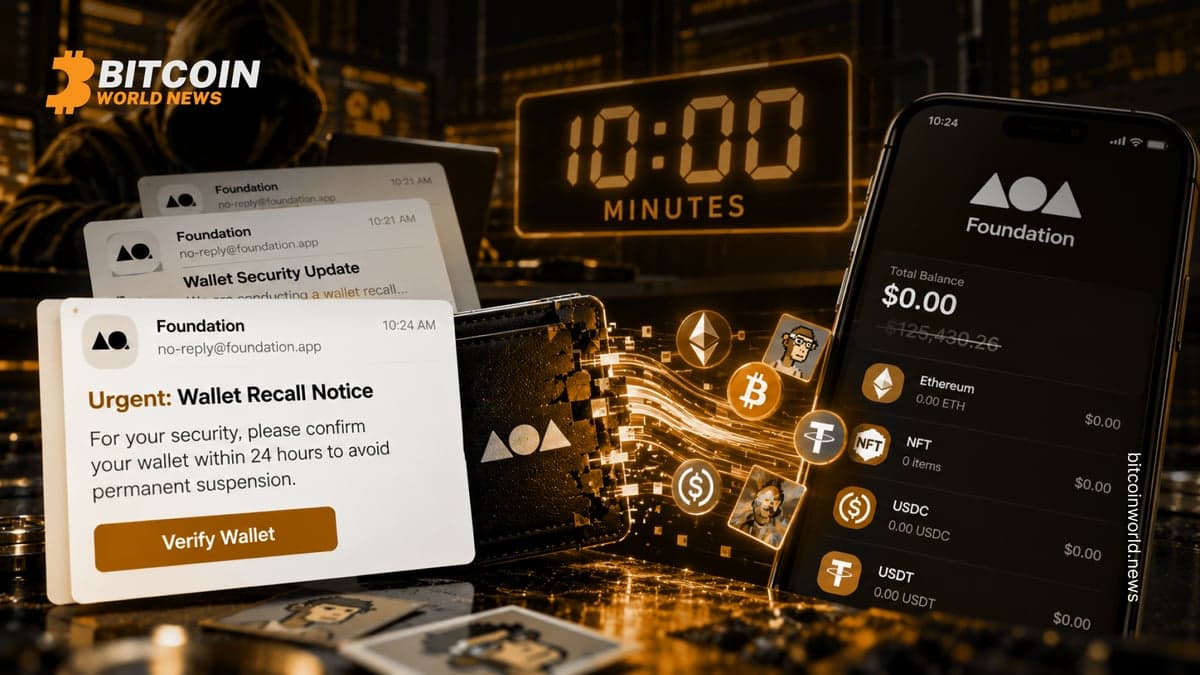
Hardware wallet manufacturer Foundation disclosed a targeted security incident late Oct. 25 after attackers hijacked its email infrastructure and sent fake recall notices to customers. The messages leveraged real names, physical addresses, and purchase details, raising concern over the exposure of personal information and the precision of the phishing attempt. Foundation said it removed the intruders within ten minutes of initial user reports.
The company said the campaign was enabled by compromised Cloudflare API keys, which allowed the emails to appear from official domains. The phishing notices warned Passport hardware-wallet owners of an urgent product recall and claimed that compromised display components could expose their Bitcoin (BTC) to theft. Recipients were steered to a counterfeit website mimicking the Envoy companion app.
What did the Foundation breach involve and how did the phishing work?
Attackers obtained access to Foundation’s email infrastructure via compromised Cloudflare API keys and sent recall emails that looked legitimate, using customer names, addresses, and purchase information. Those messages alleged a Passport display issue and directed users to a fake Envoy-like site, aiming to exploit urgency and brand familiarity to harvest sensitive actions.
The precision of the operation turned standard phishing into a targeted attack, as the inclusion of authentic buyer details increased credibility. By sending from domains that appeared official, the emails bypassed casual scrutiny. The counterfeit website mirrored Foundation’s branding to lower suspicion. The incident underscores how customer data, when abused, can meaningfully raise the success rate of social-engineering attacks against cryptocurrency self-custody users.
How quickly did Foundation respond, and what exposure is known?
Foundation said it expelled the intruders within ten minutes of user reports, limiting the window for additional emails and follow-on fraud. The company acknowledged that personal data—names, physical addresses, and purchase details—were used in the phishing campaign. The firm detailed the initial access as stemming from compromised Cloudflare API keys and noted the emails appeared to originate from its official domains.
While the attack’s duration was short, the use of authentic customer information raises ongoing risks, particularly for repeated phishing or social-engineering attempts. The focus on Passport owners, coupled with a fabricated recall over display components, was designed to induce immediate action. Users who received the emails are advised to treat any recall claims with suspicion and verify authenticity via trusted channels before engaging with links or providing wallet-related information.
Event | Detail |
|---|
Disclosure timing | Late Oct. 25 |
Initial access vector | Compromised Cloudflare API keys |
Attack method | Phishing via fake recall emails |
Targeted product | Passport hardware wallet |
Response window | Intruders ousted in ten minutes |
Data abused | Names, addresses, purchase details |
Why does this matter for self-custody and Bitcoin users?
Self-custody is only as secure as the processes protecting keys and the communications guiding user actions. Here, attackers fused domain-level spoofing with verified personal data to craft believable prompts for urgent wallet-related steps—conditions under which even experienced Bitcoin users can make unsafe choices, including visiting counterfeit sites or sharing sensitive actions.
For cryptocurrency users, trust signals like recognized sender domains and correct mailing addresses are no longer sufficient. This incident highlights the need to independently verify any recall or upgrade instructions through official apps or support portals reached via bookmarked links, not email. It also spotlights the importance of revoking any exposed API credentials promptly and hardening email and domain configurations against abuse.
What should customers and the industry watch next?
Customers should monitor for follow-on phishing waves that reuse stolen personal data and be alert to any recall-themed messages. Industry participants will watch for detailed remediation steps, including credential rotation, domain and DMARC/DKIM/SPF hardening, and user notifications outlining which data fields were exposed. Clear guidance on verifying the Envoy companion app and avoiding counterfeit sites will remain a priority.
More broadly, hardware wallet providers may reassess third-party integrations and API key hygiene, tightening controls around email infrastructure and brand impersonation. As attackers continue to pair data exposure with precise social engineering, timely incident disclosure and rapid credential invalidation are critical to containing damage.
The immediate risk is phishing-driven account compromise via user error, not a cryptographic break of hardware devices. That distinction matters: users who ignore unverified recall emails and interact only with trusted application paths can significantly reduce their exposure while providers shore up defenses.