Bitcoin Outperforms the S&P 500
Bitcoin delivered a rare performance against U.S. stocks on Monday, rising 2.6% to move above $64,000 while the S&P 500 declined 0.52%. The move gave BTC its strongest daily performance in more than a month, according to CoinDesk data.
The contrast was notable because Bitcoin not only outperformed the S&P 500 but also moved in the opposite direction. Historically, Bitcoin has behaved as a higher-beta asset than equities, meaning its price has generally experienced larger percentage moves than stocks in both rising and falling markets.
For investors tracking the relationship between crypto and traditional markets, the latest session provides an important signal that Bitcoin's recent pattern of lagging behind U.S. equities may be starting to change.
BTC Has Mostly Lagged U.S. Stocks
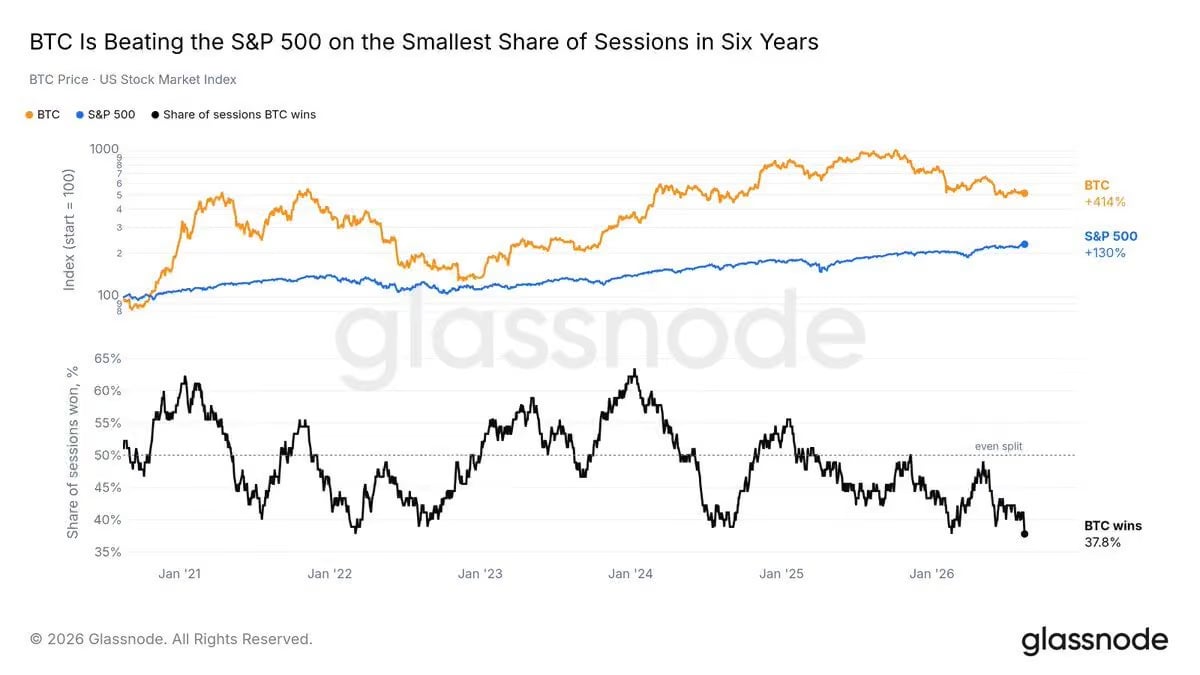
Bitcoin's latest gain stands out because BTC has underperformed the S&P 500 on most trading days over the past three months. Blockchain analytics firm Glassnode said Bitcoin outperformed the U.S. benchmark on only around one-third of trading days during that period.
That performance represents a significant change from Bitcoin's traditional higher-beta behavior. Instead of amplifying moves in the stock market, BTC has recently behaved more like a lagging risk asset.
The S&P 500 remains one of the most widely followed benchmarks for U.S. equities. Investors can track official index information through S&P Dow Jones Indices.
Why Bitcoin Has Been Underperforming
One factor behind Bitcoin's recent weakness has been the strong performance of artificial-intelligence-related stocks. The AI-driven rally in U.S. equities has attracted substantial capital, potentially reducing the amount of liquidity flowing toward other risk assets such as cryptocurrencies.
Bitcoin has also been dealing with the effects of its broader market cycle. BTC reached a record above $126,000 in October last year before entering a prolonged period of weakness.
The four-year Bitcoin market cycle remains an important part of the broader crypto narrative, although the timing and depth of individual cycles are never guaranteed.
Bitcoin's Correlation With Stocks Is Changing
Bitcoin's relationship with traditional markets has changed considerably over time. During some periods, BTC has moved closely alongside technology stocks and broader risk assets, while in other periods it has diverged significantly.
Monday's performance is an example of that divergence. Bitcoin climbed while the S&P 500 moved lower, suggesting that crypto investors were willing to buy BTC even as broader U.S. equity sentiment weakened.
For more information about Bitcoin's underlying network and technology, readers can refer to the official Bitcoin.org website.
BTC's 2.6% Gain Marks a Notable Shift
Bitcoin's 2.6% daily increase was its strongest performance in more than a month, helping BTC reclaim the $64,000 area.
The move is particularly significant because Bitcoin had recently struggled to keep pace with U.S. stocks. A sustained period of outperformance could indicate that capital is beginning to rotate back toward cryptocurrencies.
However, one strong session is not enough to establish a lasting trend. Traders will likely watch whether Bitcoin can maintain its gains and continue outperforming equities over the coming weeks.
Bitcoin's Four-Year Cycle Remains in Focus
Bitcoin's historical four-year cycle is another factor influencing market expectations. BTC's move above $126,000 last October was followed by a prolonged decline, leading some analysts to expect the current bear-market phase to reach a potential bottom around October.
However, Bitcoin's historical cycles do not operate according to a fixed schedule. Changes in institutional participation, spot Bitcoin ETFs, macroeconomic conditions and broader liquidity can influence the timing and severity of market cycles.
The official Bitcoin Core project provides technical information about the open-source software that supports the Bitcoin network.
What Bitcoin's Outperformance Means for Investors
Bitcoin's Monday rally provides a welcome change for BTC bulls after several months of relative weakness against U.S. equities.
If Bitcoin continues rising while the S&P 500 struggles, it could signal that the cryptocurrency is beginning to regain its traditional high-beta behavior. That could become particularly important if capital starts rotating away from crowded AI and technology trades.
For now, however, investors should treat the latest move as an encouraging data point rather than confirmation of a broader trend. The key question is whether Bitcoin can turn one day of outperformance into a sustained period of strength against the S&P 500.