

Are Bitcoin ETFs Quietly Accumulating — or Just Not Selling? The Flow Data That Matters
Summary
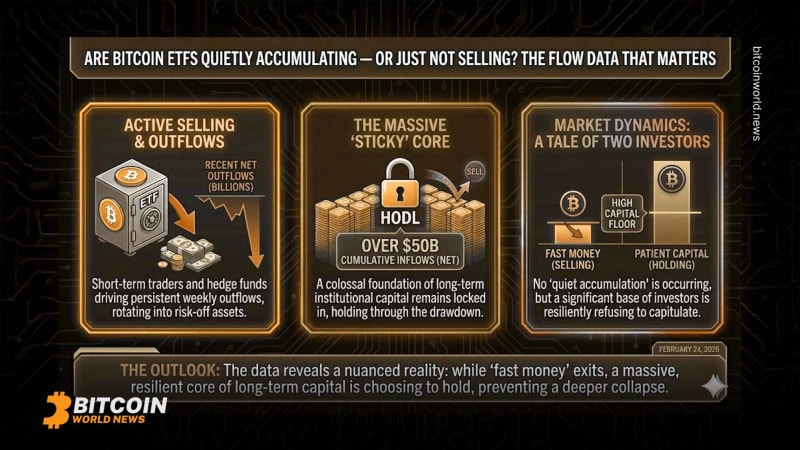
- US spot Bitcoin ETFs are on pace for a fourth straight month of net outflows.
- ETF holdings have fallen by roughly 85,000–87,000 BTC since October 2025.
- Gold ETFs have attracted stronger rolling inflows during Bitcoin’s demand slowdown.
- Macro conditions — particularly positive real yields — may be limiting renewed BTC accumulation.
Four Months of Outflows
Bitcoin is approaching a fifth consecutive negative monthly close, while US-listed spot Bitcoin ETFs continue to show persistent capital outflows.
Key figures:
- Net ETF assets peaked near $170 billion in October 2025
- Current net assets: ~$84.3 billion
- Cumulative net inflows have declined from ~$63 billion ATH to ~$54 billion
- Since July 2025, net cumulative flows total just ~$5 billion
ETF balances have dropped from roughly 1.36 million BTC to 1.26 million BTC, implying around 85,000–87,000 BTC have left funds since the peak.
Rather than quiet accumulation, the data suggests net distribution — albeit measured rather than panicked.
Short-Term Flow Breakdown
Bitcoin researcher Axel Adler Jr. tracked ETF flows between Feb. 12 and Feb. 19:
- Total net outflows: 11,042 BTC
- Feb. 12: Largest single-day reduction at 6,120 BTC (~$416 million)
- Feb. 17 & 18: Consecutive outflows of 1,520 BTC and 1,980 BTC
- Only two sessions during the period were positive
According to Adler, three consecutive positive sessions would be needed to confirm renewed accumulation.
Until then, ETFs remain a modest source of supply to the market.
BlackRock and Fidelity Trim Holdings
The largest funds have seen controlled but notable balance reductions:
- BlackRock’s IBIT:
- 806,000 BTC → 759,000 BTC (–6%)
- Fidelity Investments’s FBTC:
- 213,000 BTC → 186,000 BTC (–12.6%)
Importantly, ETF balances have declined far less dramatically than Bitcoin’s price, suggesting gradual repositioning rather than wholesale capitulation.
Gold ETFs Are Winning the Rotation
A major theme in the flow data is capital rotation between Bitcoin and gold.
Over the past two years, leadership has alternated based on 90-day rolling inflows:
Bitcoin ETF 90-Day Flows
- March 2024 peak: ~$16 billion
- December 2024 surge: $21.6 billio
- March–April 2025: Fell to –$2 billion
Gold ETF 90-Day Flows
- Negative until July 2024
- Climbed to $30 billion by April 2025
- Peaked near $36 billion in October 2025
- Still elevated around $21 billion in mid-February 2026
The pattern shows repeated handoffs:
- When Bitcoin inflows fade → gold inflows accelerate
- When gold cools → Bitcoin often regains strength
In risk-off conditions, investors appear to prefer gold’s lower volatility and longer macro track record.
Macro Conditions: The Real Yield Problem
According to Benjamin Cowen, Q1 2026 resembles a “late-cycle restrictive digestion” phase.
Key macro factors:
- The Federal Reserve halted quantitative tightening in December 2025
- Policy remains restrictive
- Federal funds rate sits above the 2-year Treasury yield
- 10-year yield: ~4.1%
- 10-year real yield: ~1.7–1.8%
Positive real yields increase the opportunity cost of holding non-yielding assets like Bitcoin.
Historically:
- Durable ETF inflows coincide with falling real yields
- Or with clear monetary easing cycle
Neither condition has materialized yet.
Are ETFs Accumulating — or Just Not Selling Aggressively?
The data suggests:
- ETFs are not aggressively accumulating
- But they are also not dumping at crisis levels
- Outflows have been persistent but controlled
- Spot demand has not been strong enough to offset broader macro pressure
This phase may reflect institutional caution rather than structural abandonment.
What Would Signal a Turn?
For renewed ETF-driven upside momentum, markets likely need:
- Sustained positive net inflows
- Falling real yields or explicit monetary easing
- Broader macro risk-on sentiment
Until then, Bitcoin ETFs appear to be in a distribution-to-neutral holding phase, rather than active accumulation.
See all our insights: Bitcoin World News
Disclaimer: The content on this website is for informational purposes only and does not constitute financial or investment advice. We do not endorse any project or product. Readers should conduct their own research and assume full responsibility for their decisions. We are not liable for any loss or damage arising from reliance on the information provided. Crypto investments carry risks.